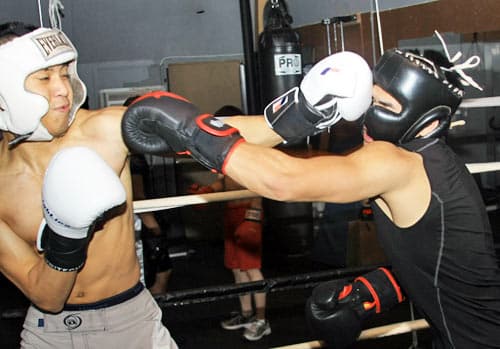
This is a guide base solely on training out your flinch reflex. I’m talking about the natural reflex where a fighter may blink or close his eyes and stiffen up his body when he sees punches coming his way. It’s natural but there is a way to fight through it. You basically have to practice.
For most beginners, the flinch reflex is when they can’t keep their eyes open when they are taking punches. For other fighters, it has to do with them panicking a little and holding their breath when they’re taking punches. This only makes their condition worse since they will get the wind knocked out of them when they get hit with a clean punch. In fact, part of the reason why fighting in the ring is so tiring is because people can’t overcome their flinch reflex and so they keep freaking out and holding their breath instead of relaxing.
2 drills to help you get rid of that flinch reflex
Glove-Tapping Drill
This is a very basic drill but is still recommended for all boxers regardless of their skill level. Basically the boxer walks around the ring forwards and backwards as the trainer (or another boxer) keeps tapping him on his gloves. (These are not properly thrown punches, it’s just a bunch of quick gloves taps from the “attacking” boxer. You rapidly tap his gloves at awkward rhythms.) The point of the drill is for the defending boxer to be able to block all the light punches while keeping his eyes open and his breathing in perfect rhythm. It will take a lot of practice but soon you will be able to take punches without getting your rhythm broken up.
Jab – Jab Counter Drill
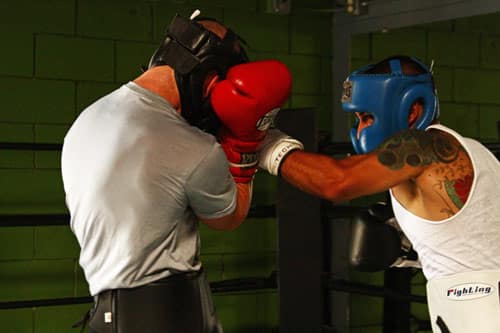
Many fighters lose because they have not perfect this drill. This drill basically prevents you from leaning back when you’re taking a punch. Basically you and another boxer will move around the ring taking turns at jabbing each other. Here’s how it works: Boxer A jabs at Boxer B first. Boxer B immediately cuts the jab short by blocking it with the right hand and returns with a counter-jab at the air ABOVE Boxer A’s head. NOW HERE IS THE CRITICAL POINT: when you are taking a jab, do NOT flinch and lean back to cushion the punch! Instead, you must quickly stop the punch and then step forward and make an assertive counter-jab into your opponent. It will take time but soon you will be able to quickly catch a jab, and instantaneously return a counter without wasting a split second by leaning back.
Once you learn these basic drills, you can learn the next reflex drill which is the [Push Down and Counter On Top]





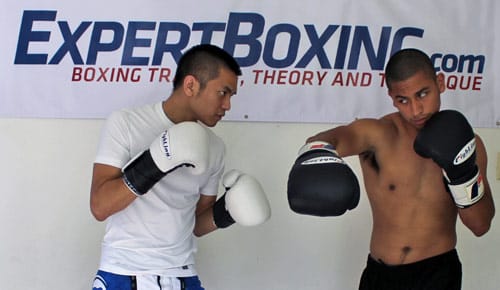
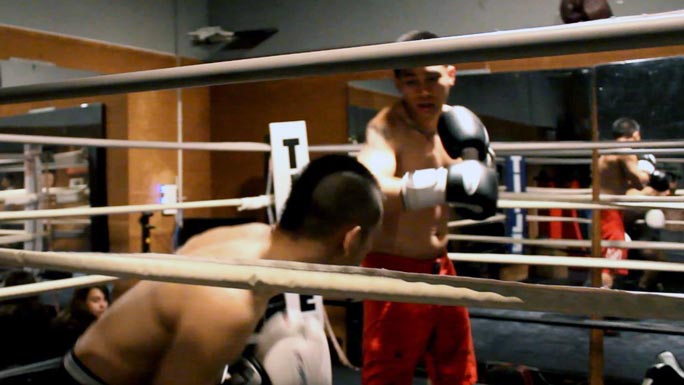
jab- jab counter
thanks for providing this and other useful information. i’m attempting to coach my 8 year old son
Thanks! Do feel free to ask questions from time to time if you need any assistance. I’ll be happy to help.
im sort of new too boxing…i was wondering …what are the steps to being a pro aka a paid boxer ?
Find a gym where pro’s train at. Come in there and talk to the owner, tell him you want to go pro. He’ll introduce you to some trainers and managers and they’ll check you out. If you’re willing to train hard and put up a good fight, they’ll pay for your boxing license and medicals and off you go!
I sparred for the first time today. Im pretty quick and powerful i must say. but i noticed almost everytime i threw a punch, i either flinch blinked or turned away while throwing it. though it landed, how can i get used to keeping my head forward and being confident enough to throw it. or being able to adapt to what will happen next when i throw the punch without turning away or flinching?
i am a boxer i want to train to fight in the ring,i need a strong coach to teach me to fight i will fight with all my heart,
thanks
yours faithfully
victor mark
strenth
Good stuff
stuck in the mud
All good tips.
For someone like me, who is just a few months in but has quick back stepping reflexes, I enjoy ‘stuck in the mud – I’m not allowed to move my feet while the trainer throws slow combos – jabs, hooks, crosses…
I can bob, weave, parry, catch, or block with the elbows (elbows in tight to the body).
Keep up the good work!
hi im a boxer and i’m 13 and these are the drills are do but there very good tips to be fit and be stronger
good stuff
I have a big problem when sparring I always lean back I have got to break this habit if I wanna fight soon plz help
lean aside or duck instead,
beating the lean back habit
Learn to use your defense and spar at a slower speed with guys that don’t intimidate you with their power. You need a chance to get accustomed to not be afraid during sparring. You also need to do more shadowboxing and footwork to get use to not leaning back. You can also try building a habit of where instead of leaning back, you just step back entirely. Also remember to keep yourself off the ropes so you always have room to step back when you need.
this is a very nice drill thanks
Great!
I find this very useful however I have one problem, when a punch is coming it takes me a bit long to decide how to react, could you please help me. I’m ready for the punch but I always find the need to see whethere its a jab, hook, body punch coming to counter or block it.
Try playing jacks you can find out where to get it. Also if you become unsure jab at him and move around more… make sure you get a good examination of this genius. Look at the lenghth of his arms and legs before you scrape Him sparring and last get familier with all types of boxing styles and punches, you should practice all types of angles to punch from so you can be familier with his material. Think about it.. if someone tries to set a trap on you and you made the trap before Theres no way your ganna let yourself fall for it. Hope I helped.. let your opponents know!! I slam the hammer on the table!!!! Enforce guilt on them for dreaming about thinking of even getten close to beating you!
To be honest, deciding what a punch is will always be tricky. The only way for you to really fine-tune the reaction is to practice the defensive move until it becomes second nature. If you have to guess in the moment, there will always be a possibility that you will guess wrong. Train the reaction so it becomes second nature like blinking. It takes years to be this good. Sometimes, if you can’t figure out if it’s a jab or a hook, just roll with it and that will take some steam off.
…
Ok my huge weakness is my reach and timing. I’m fast but whats the use of it if I can’t land a hit?
.
My weakness is my reach and timing. I can move fast and be evasive but whats the use of it if I can’t seem to land a hit? Eventually my opponent will see this and gain confidence.
@ Sukaichii – I agree with you completely.
Slow and Heavy
I am getting back into boxing after about 14 years. I have a fairly stocky build and am heavy on my feet, I can’t move quick but I have immense power when I land a punch. The guy I was training with can’t seem to find any techniques that will help with this. Like I said I have the power but lack the grace and speed. Is there any help you can offer a rock?
@ Huck F – Sounds to me like your punches are fine and you just need some serious footwork and grace. Starting jumping rope. Do LOTS of jumprope. Try an hour a day, everyday for 2 weeks. Also do more shadowboxing and double-end bag. Lighten on your power and work on pure speed. Stay away from the heavybag.
no training partners
Hi, This is a great article, but I don’t have the luxury of having a training partner to practice these drills with. Do you have any suggestions/drills I can do by myself without a training partner in order to get rid of my flinch reflex? Thanks a lot.
Started boxing training about 6 weeks ago. I’m 42 with no prior boxing experience. I’m pretty fit and my trainer says I have some natural ability. Taking it up as a challenge and to take my fitness to another level. Have been sparring with some bigger guys and took some punishment in my last session. After reading your advice on sparring I want to take it back a level as got quite beat up during the session. Flinching still happening but getting better. Thanks for the tips. Will keep practising. Aiming for first fight in a couple of months. This site is really helpful.
@yo – reflex training is all about training yourself not to flinch to somebody’s else movement. More specifically, you want to not to flinch to somebody’s else punches. It’s a bit hard to train this without somebody actually throwing punches at you. Even if we find another way to train, there’s no guarantee the anti-flinch reflexes you developed will stay when you enter the ring. It’s just easy to train with a partner…and maybe even multiple partners so you get used to looking at multiple punches.
@stewy – awesome! (you doing boxing…not the getting beat up part). Keep up at it and good luck on your first fight.
lone wulph
are there any solo exersices to train out your flinch reflex, or more importantly mine?
The best solo exercise is probably to work with a double-end bag.
Sorry to be mentioning my robot boxing arms again, but I’m being honest when I say they really helped me not to flinch and not turn my head. It is much better to keep looking and stay focused so you can block and counter. A fast blink takes about 100 ms and a normal blink takes 400 ms. A fast jab takes about 160 to 200 ms (that’s with no tel’, add to the time if there was a tel’). An average “good” reaction time takes about 200 ms, meaning once your brain tells the muscles to move, it won’t happen till 200 ms go by. I trained hard to be able to get my muscles to start to move in 100 ms or less, but I still have to factor in time to move to block.
The point I’m making is, you HAVE TO keep a sharp lookout and detect a punch RIGHT FROM THE START to be able to have a chance to block it, that means seeing it happen. Hopefully, your opponent is like most fighters that have not learned to not give a tel’ when they strike. You have to practice not flinching and realize it makes getting hit worse.
I didn’t know about those reaction times! Good stuff, John.
When I get back to sparring once my leg is fully recovered, I’m sure going to be going over both exercises. I might practice on my siblings first (thats what they’re for, right?).
Laura, I’m glad I don’t have you for a sister. 😉
Hey Johnny
Great Artical. I have one question…will premediated mitt training defense help me get more fimilar seeing punches? Like if I had a friend throw punches at me and I block the mitts…even If i know What punches will be thrown?
Pre-mediated training helps you improve form and technique. Random training helps improve reflexes and response.
when you say random training do you mean punches that are thrown at me thats not pre-mediated?
Exactly, Que.
Won’t jabbing the air above boxer a’s head will make used to jabbing the air above my opponent’s head when I actually fight?
The drill is to work on the flinch reflex, not jabbing the air. So focus on the flinch reflex. The bad habit you described will not be a problem with this drill.
Your website is really good and it has helped me alot. I really love boxing and got into it recently. I want to take up boxing as a profession but the problem is i dont have a boxing gym in my city and im 19 years old i did manage to get the equipment at home, i’ve got the dedication and i work daily so do you think that i have a chance
You need to find a gym. You need experience and sparring partners and guidance of experienced coaches. Training alone is not going to prepare you against opponents that practice everyday under the supervision of world class trainers.
when you first started johnny were you a natural or did you have to work hard?
I didn’t have natural reflexes. I had a lot of flinching and panic reflexes. After proper training, I developed trained reflexes. Now I’m pretty comfortable.
I always wondered why Floyd Mayweather would just tap the mitts and his uncle would just kinda throw punches at him
Because they’re working on coordination and reactive movement. Floyd’s been punching for years so he’s not worried about working on proper punching form or power.
This is a subject I did experimenting not only on myself but on others, some were experienced boxers. I’d shoot my mechanical punch arm at their face, sometimes just out of strike range and other times in strike range. I’d watch their eyes. At first they’d blink a lot and then start blinking less within minutes of practice. Then when I turned up the speed, the blinking would come back and then get less again with more practice.
So I got a higher speed video camera and did experiments on myself to see how I improved since I use the punch arms so much. Just out of range even at high speed I didn’t blink at all anymore. When in strike distance I only blinked once the hit was felt on my face guard. At first I used to blink and flinch often but I learned by practice from the punch arm to stay focused.
A blink can take from 100 to 400 ms. A fast jab from guard position takes about 160 to 200 ms from most pros, so if you blink, BAM!.
You can see versions of how my mechanical arms are used on my Youtube channel: 2fast2block
With practice, they WILL get rid of the blink/flinch reflex. After practicing with them in superman speed (over-speed training) you’ll feel relaxed at human speed punches.
I can see how the arms would help boxers develop their reflexes. I’ll have to try it.
What about leaning back and Immediately coming forward with a jab or cross? I’m new to boxing I have a natural fighting ability and was taught to punch correctly at a early age, but my brother and I use to do this “drill” when when we were younger leaning back with are feet planted and coming forward with the jab. Didn’t Ali do something similiar and doesn’t mayweather do that now or is what im doing wrong?
Well yes, it’s a simple trick that works. When done right by a masterful boxer, it can quickly take him in and out of range which lightning quick jabs. When done by an amateur, it only leaves you off-balance and vulnerable a more skilled opponent who can push you back and/or counter you if lean too far forward while reaching with your jab.
The move your talking about relies more on distance awareness and timing as opposed to a simple body position. A more skilled opponent will defeat that tactic if he does it more skillfully (with better technique and/or timing) than you.
thanks for the tip, i’ve been parrying most punches now or just putting my hand up to block.
Hi! Two questions : 1 why not to hit heavybag? 2 Other exercires to not closing my eyes or blink ?
1 – I already have a guide for this. It’s called “8 Reasons Why Heavy Bags Suck”. Despite the title, the heavy bag is still very useful. The article is only for those who hit the bag too much.
2 – Other exercises? How about more focus mitts and slow sparring.
But Johnny,
isn’t it ok to lean back at times when the opponent comes at you with a jab? I usually just jab back so we hit each other almost simultaneously, or I lean my head back so they miss, then come with a counter.
The lean-back trick is perfectly fine as long as you know how to do it in a subtle way. If you do it too much then you’ll get balance issues and stronger guys can push you around or make you give up ground.
Thanks, very useful tips.
How would you dodge a hook ? I’ve been taking hooks in for all matches and it’s starting to get punishing .
There’s only 2 ways, go under it or over it (which is pulling away). Find out which was is easier for you. The secret is detecting the hook EARLY.
Hey johnny nice article.Im am practicing muay thai so im not exactly a boxer but my trainer said my best part are my punches so i wanted to ask shouldi switch the normal thai guard to a more boxing one?
I don’t know anything about muay thai but if it were me, I’d stick to a normal thai guard until I’m skilled enough to do whatever I want. I think the normal thai guard is “standard” for a reason.
Ok thanks for the tip
Hey Johnny i would like to first say your site has been a great help to me and you do a great job with the site! Great work.. I have a question regarding on how to stragetically fight a boxer who keeps his hands low all the time? its very fusturating i can never see them coming and the only options i have seem to think of are keeping my hands low like him which is not a godd idea fighting his fight or be anagressive fighter constantly pressuring him not letting him get comfortable.. If you any tips for me it would be greatly appreciated!
Sincerely
Kyle B
Stop trying to focus on his position and focus more on his movement. Counter his punches the way you were taught to counter. Quite often, guys with their hands down can have better speed, range control, body movement which makes boxing a little easier for them. Keep working on your skills and work to COUNTER HIS MOVEMENT. Every boxer is open when he punches.
Hey Johnny Major helpful thank you Bro I wanted to know Does playing chess help me when it comes to boxing speaking on such as thinking 5 steps ahead?
In general, no.
I was once a 5th place finalist in a high score chess tournament and I can tell you the skills didn’t transfer over to boxing in any way.
Hey johnny, ive watched almost all your videos there very good, im new to boxing and just wanted to ask how do i stop my self from closing my eyes each time a punch comes towards my face, cause i cant control it as soon as i see a punch towards my head i just turn away or close my eyes any tips?
Train slower because you’re going too fast. With time, you will be able increase intensity. It’s the same as how I would expect you to be able to take a full power shot to the stomach because you’ve haven’t developed that ability to take punches yet.
Hi I am new to boxing , how should taller people box ?
Like anybody else. Good basic technique for punching and defending. Use the jab.
This web site that you have put together is an excellent rescource. Im pretty late to boxing, started only a couple of years (aged 34 now) ago to help my hands with Muay Thai and discovered I like boxing a lot more. I have been told by my trainers that I have good technique, balance, foot movement etc but I know that I need to work on my flinch reflex. Its easy to hit something that dosent hit back with good technique haha but I want be able to actually box. I have been all over your site and found the advice you have extreamly good. Im wondering if you have any more pointers you can give to an old guy like me to help speed up the process of becoming a decent boxer?
Slow sparring. Go for an hour straight every day.
Once again, your articles are just what I needed. I have read quite a few of the comments (not all) in hopes I would see one similar to my concerns.
I saw a couple that were close but not quite what I am wanting to ask.
So first, minus two weeks of boxing instruction at the gold’s gym in Yokosuka, Japan, two days instruction at a boxing gym in Chicago, and a salty old Irish/Mexican Navy Master Chief tossing me a few pointers here and there while we were fixing diesels, I am self taught.
I came to boxing out of traditional martial arts and mma after I sparred off with an amateur Nicaraguan boxer who beat the ever loving snot out of me. Going in, I knew i was strong, I knew I could take a shot, and I knew all the punches. What I realized what that I didn’t know jack diddly about boxing.
This guy destroyed my fighting ego. I had to admit that I wasn’t as good as I thought I was. So, I started recording myself and I noticed that when people punched, my head was all over the place and where I before that I was doing effective dodging, I realized that I was just exposing myself to greater shots. even guys who I was better than, had they been better could have easily capitalized on this.
and like one guy before, I don’t have a sparring partner. So, I’ve been putting up a speed bag on an extended cord, jab and crossing it and attempting to move my head at the last minute, only after I’ve seen that the bag is coming for my head, and not so far as to be an over extended head movement.
do you have any other pointers or drills that maybe I could incorperate?
The best drill for you is slow sparring. You can train all you want on a mechanical device but at best you’re only developing “fight choreography”. What you need is somebody to throw realistic human punches at you so that you become more used to seeing them. It’s very hard to react to something you can’t see. And that’s where your problem (and every beginner’s problem) truly lies. All the time you spend looking at a bag, these trained fighters are spending against live opponents. And then when you face them, you lose all over again.
Boxing is a competitive sport. You have to fight against others. So yes, slipping against a bag can make you better. But it won’t make you better than a guy who practices against live humans.
Hey bro,
Thank you for the reply for one.
and then
Thank you for the advice. I see what you mean. I mean, it makes sense that the only way to get better at something is to do it.
Question for you, I came up with this thought the other day that I would put on head gear and let someone throw light punches at me, similar to the kyokushin body and leg training. What do you think on that?
Because I only have one person willing to spar with me, and he rolls out in a month. So I need to entice people into feeling tough. So I tell them that they can practice punchin on me.
Anything is better than nothing. But ultimately that tactic fails because the better your opponent, the more you cannot just let him punch you for free. Offense is the best defense. And by you deciding not to throw back any punches, you are failing to practice your most important defensive maneuver–the counter punch.
What if I were to practice rolling with shots, slipping, etc… as in creating the openings and eating shots? do you think this would be a healthy medium? And I haven’t noticed it, but do you have an article on using footwork to avoid shots? I could use a few pointers on defensive footwork.
You can practice anything you like if it helps, then keep doing it. I do have several guides regarding footwork and also helpful videos on the Youtube channel. Check them out.
Great advice..encouragement.. Having gone through ,Shotokan, Kempo etc.. I wind up back at the begening..ie: boxing workouts ironic that at 61 years of age it is doable if you accept your limitations and know yourself.. Great stuff Ill keep on looking around. Finaly able ,with your instructions,how to use the double end bag . I understand now why its so advanced and difficult but essential.. Thanks
Hey Johnny,
First off, thanks for this site. It’s really encouraging and insightful. I’m new to boxing although I grew up doing first Karate, and then Tang Soo Do. I just started doing formal training about two months ago because of chessboxing. Although I believe there must be some way(s) to speed up improvement and development, my trainer says there are no ways to speed up this process and that it takes a long time. What all should I be doing to grow as a boxer? I’ve learned all the basic punches and all the basic movements, and I would like to learn how to train. What drills/exercises can I do on my own? What must I work with a trainer on? How often should I be running, how much and what other cardio or strength exercises should I be doing and how often? How soon is too soon to spar and what do you mean when you suggest slow sparring?
Slow sparring means sparring at a slow speed. Almost slow-motion if you’re a beginner. The best thing I can suggest to you on this site is to read the “Beginner’s Guide to Boxing” and follow it as best as you can. Good luck and welcome to boxing, Jarrett!
Johnny, I’m SO glad I stumbled across your site. Thanks for all the great info. I’ll have to try these drills to help me with my flinch reflex. I just turned 48 and started Muay Thai classes with my 14 year old son a few months ago. I’ve sparred a few times, and although I’m proud of myself for getting in there and trying, I’m getting knocked around quite a bit. Yes, I read your great advice about sparring. Any encouragement would be appreciated. I’ve always been mesmerized by boxing (might even quit muay thai to just box), and I’ve remained fit and athletic over the years, so I’m hoping it’s not too late to spend a couple of years gaining some real boxing skills. I’ll keep checking back in. Also- Any clue on a quality boxing gym in the Oklahoma City area?
Oops, forgot to include my email
There is this kid at school always threatning me that he is going to beat my a** and I take martial arts classes, but I always flinch to everything and I have slow reflexes what should I do?
Do slow sparring so you get better at seeing and reacting to movements. This will help with your flinching reflex in the long run.
I am 18 soon turning 19
gonna have my first fight next month, kind of a silly quiston but is it possibly to even go pro when i gonna get my first fight at 18? some people at my gym just turned 18 and just turned pro ..
does hard work realy beat talent in boxing? some people at the gym who is not even trying just ben boxing sense childhood not serious about it they only have the technique i can be stronger faster than them but they got the advantage of more technique and that pisses me off knowing some of them they are not training as hard as me
Hey, I just wanted to ask how many fights you’ve had and if you could possibly share them. I’ve been boxing for one year and about to get my license, I would like to watch your fights and pick up how to actually do the subtle/less well known skills. Thank you
In short I’d like to see what conditions are needed for stuff to be done and what it’s actually like in practice.
Hey I’m boxing for like 9-10 months and I’m traning really hard
My height is 6’1 and I’m 15 yrs old . I have to fight maintaining the range but my eyes close at the time my opponent rushes into me and I lean back and counter with right but sometimes my opponent misses the punch and punches me …
Plzzzzz hellpppp
I would love to train with someone .so I could overcome this problem.