Learn how to eat right to fight harder, gain lean muscle weight, burn fat, or just look sexy! This isn’t just a boxing diet plan, it’s a common sense diet plan for anybody to feel and look like a champ!
A NOTE TO THE READERS: I’m hardly an expert on nutrition or dieting. I barely know how to cook! HOWEVER, I did speak to boxing coaches, personal trainers, fighters, doctors, one nutritionist, and even friends that lost weight. If there was anybody that could teach me anything about dieting, I made sure to ask them. Most importantly, I made sure that everything the experts told me did not conflict with anything my trainers told me. The following is a combination of their knowledge and my own personal experience.
Boxing Diet for Lifelong Health
Fortunately for me, boxing was my catalyst to seeking healthy food. I was born with fast metabolism and stayed skinny my whole life. It wasn’t until I tried boxing that I saw the difference between looking in-shape and being in-shape. You must eat well to perform well and it was then that I realized the true value of good nutrition. If it wasn’t for boxing, I might have eaten junk food for the rest of my life.
Poor Dieting Habits of the Modern Lifestyle
I blame recent technology and modern society for creating busier lives and contributing to poor eating habits. It is more convenient, socially and personally rewarding to eat crap as we maintain busier lifestyles in school, work, or training. Time-crunched days often lead to frequent periods of starvation and over-eating. Diet conveniences come in the form of junk food or restaurants more focused on providing a “dining experience” than actual healthy food. The only thing most people know about healthy dieting is “fat is bad and avoid junk food” and yet the average person today eats more junk food and fat foods than ever before.
Proper dieting has become quite the mystery over the years. I’m not sure how it came to be that we humans have lost our ability to eat intelligently, something we were born to do naturally. (Did you know the primary reasons for evolution of vision/smell/taste in humans was to detect and differentiate between food?) Despite those advantages, many individuals that have tried to eat healthy are met with conflicting information and demoralizing results.
The human body has remained virtually the same for thousands of years yet there are new diets coming out EVERY YEAR! The way I see it, successful marketing has been repackaging the same facts about proper dieting over and over again to be resold to the poorly-informed (and overly self-conscious) public.
I’ve heard of the protein diet, the atkins diet, the vegetarian diet, the high-carb diet, the low-carb diet, and the SLOW-carb diet. I’ve been a successful athlete my entire life without ever following any of those. At worst, these diets restrict your food intake to ridiculously small amounts. These crazy diets work for a little while, until your body suffers from starvation or deficiencies in essential nutrients. At best, these diets are simply a new name for a good old fashion healthy diet!
I don’t need to reinvent the science of nutrition. The secret to eating right has more to do with common sense than all the science in the world!
Dieting Common Sense:
You need to eat everything.
- Carb, protein, fats — they’re all essential to your body; the key is moderation.
You need to eat at the right time.
- Don’t starve when your body needs energy, and don’t over-eat when you have enough. Timing your meals allow you to stay full on less food.
Your diet should fit your needs.
- Diets are not one-size-fits-all. Everyone’s bodies, lifestyles, diets, and dieting goals are different. A weight loss diet for one person might lead to weight gain for another.
Healthy dieting requires:
TIMING (of meals)
VARIETY (of foods)
BALANCE (of nutrients)
MODERATION (of portions)
The Boxing Diet
As a fighter, eating properly increases your performance, decreases your recovery time, while maintaining a lean (and sexy) body weight. Boxers need more nutrients than the average person to workout, develop and repair the body.
A boxer’s diet must:
- provide energy for physical performance
- provide nutrients for rapid muscle development
- decrease body fat
The boxing diet varies from a normal diet in that you have to center your diets around your workouts. You need nutrients to fuel the intense workout and begin recovery right after. Eating around the workout is what makes the boxer’s diet so hard. It’s easy to under-eat and end up starving during your workout or over-eat because you feel so hungry after the workout. It’s not enough to say that “an athlete requires more nutrition than the average person.” Managing the boxer’s diet is TRICKY! There’s timing, calculation, and balance involved!
The boxer has to eat more, without over-eating!
WHEN to Eat
Knowing WHEN to eat,
is as important as knowing WHAT to eat.
Our #1 problem is figuring out when to eat. (Most people know what to eat. Fruits are good, junk foods are bad, etc) If you’re eating healthy but still not losing weight, it’s probably your timing that’s off. If you don’t eat at the right time, it matters very little whether you eat healthy or not–because the food gets transformed into fat anyway!
The #1 diet problem
Not eating when the body needs food,
and then over-eating when finally eating.
… so when do we eat?
Timing Your Meals
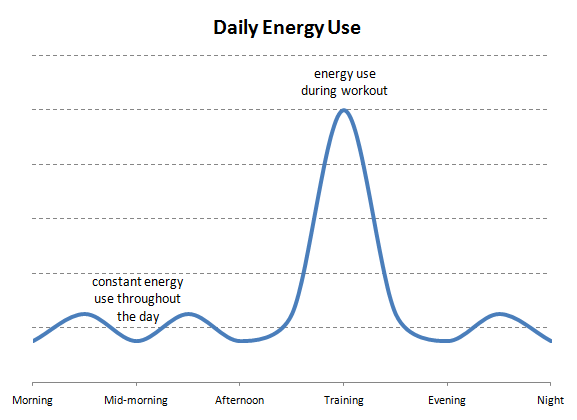
The body’s daily energy use
- Your body is constantly using energy, spiking its energy use during your workout.
- Your boxing diet should follow your energy use as closely as possible.
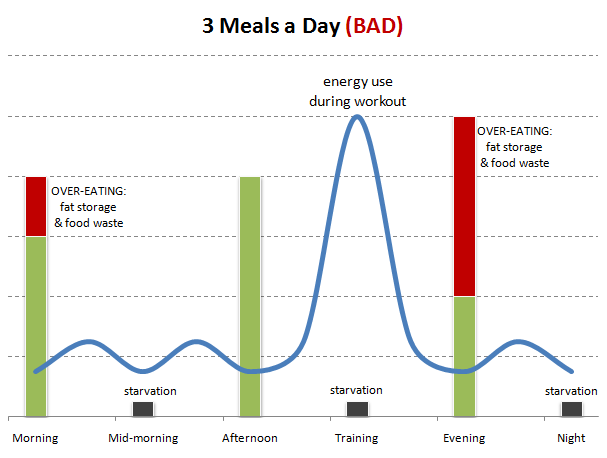
Bad diet plan of eating 3 big meals a day.
- over-eating converts surplus nutrients to fat
- fewer meals leaves you hungry & weak in between meals
- starving often leads to more over-eating
One of the biggest diet mistakes is waiting too long in between meals. If you wait till your stomach is grumbling, your body is already starving (decreased energy and recovery rate). Extreme hunger is usually countered with the next diet mistake, over-eating, which increases fat storage. One mistake usually leads to the other, putting your body in a vicious cycle of starvation (decreased metabolism) followed by periods of over-eating (fat gain).
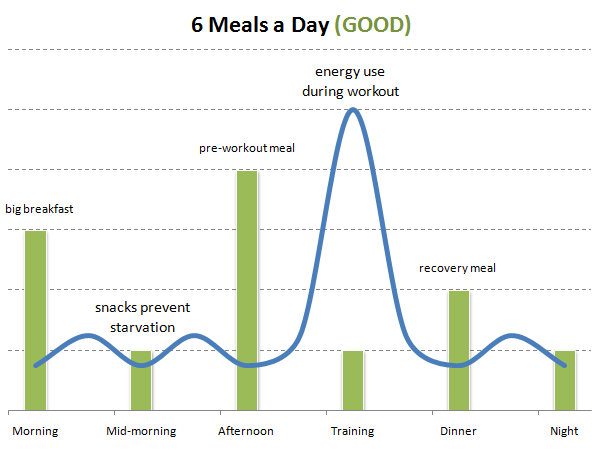
Good diet plan of 6 meals a day
- smaller meals keep you energized and full throughout the day
- snacks keep you from starving during long workouts and in between meals
- smaller meals keep your metabolism high while avoiding over-eating
Eating smaller meals more closely matches your body’s energy use. Your biggest meals are in the mornings and the one before your workout. Smaller meals keep you satisfied without putting extra calories into you.
5 to 6 Small Meals a Day
Eating 5 to 6 small meals a day is the best advice I can give and it really works. 5-6 meals comes out to about one meal every 2-3 hours. Boxers looking to make weight follow this religiously. Every friend I’ve had that lost 50-100lbs of weight (epic miracle style), did it with just this one principle alone. If there is anything you learn from reading this guide, let it be this one:
Eat 5 to 6 small meals a day!
- My friend explained meal-timing in these simple terms:
Start eating before you get too hungry.
Stop eating before you get too full.
Biggest Meal in the Morning
Breakfast is the most important meal of the day. It’s the first supply of nutrients for your day and kickstarts your body’s metabolism. Once you have a full breakfast, you can make it through the rest of the day on smaller meals to avoid getting hungry. Don’t be silly and skip breakfast as part of your weight loss plan. This leaves you hungry and sends your body into starvation mode (decreasing metabolism), making it stingy for energy and storing everything you eat as fat. You You need to have energy to start your day; you need to eat good breakfast.
Breakfast AFTER Your Morning Run
If you do your runs in the morning, it’s best to eat breakfast after that. First off, running on a full stomach is a terrible idea. Secondly, running on an empty stomach helps you lose weight because your body will be burning off stored fat instead of the food you ate that day. It’s not necessary to do your runs in the morning, but the common belief is that it burns off fat stored from the previous night and energizes you for the day.
The Pre-Workout Meal
Aside from breakfast, the workout meal is the second and only other big meal on your training day. (You don’t need a workout meal on rest days.) Essentially, the boxer’s diet is different from a normal diet because of “the workout meal”. It has to fuel your intense workout without going overboard and storing fat.
You should eat 2 hours before the workout. The workout meal should be big enough to sustain your whole workout. If you’re doing a 30-minute bootcamp sesssion, you won’t need much. If you’re like me and spend 5 hours sweating non-stop in the gym, you need a big meal. Eat light foods so that you’re not training with a half a steak still digesting in your stomach. (Meat usually takes 4 hours to digest completely.) This might slow you down or give you cramps.
If you need, have a SMALL snack before or after the workout, followed by a recovery meal when you get home. Eating within 30 minutes of your workout triggers your body’s recovery phase immediately.
A boxer needs only 2 big meals a day at most;
One for breakfast and another 2 hours before training.
NOTE: if your workout comes early in the day, it is possible to have just one big meal. You would use the same big meal as your breakfast and pre-workout meal.
Smallest Meals at Night
Later meals in the day should be kept small so that you’re not going to bed starving, but also not sleeping with unused calories. Eating before sleeping is one of the easiest ways to get fat. Your biggest meals (like breakfast and before workout) come earlier so that you have all day to burn off the calories.
WHAT to Eat
This is probably the most common subject of dieting. What should I eat?
The nutrients you need in large quantities are:
- water (essential, vital to living)
- carbs (for energy)
- protein (muscle growth & recovery)
- fats (vital to organs, secondary energy source)
Then comes nutrients you need in small quantities:
- vitamins & minerals (boost immune system, support cell growth, organ functions, healthy skin, strong bones)
- fiber (move food through digestive system, keeps your digestive system running smoothly–helps you eat less)
Basically, you need everything. Eating a wide variety of foods is key to proper functioning, growth, repair, and maintenance of your body. Deficiencies, excesses, and imbalances in diet will lead to reduced physical performance, illness, and many other negative impacts on health.
Now let’s review the different types of nutrients:
Water
Water is the most vital substance in your body; you need water to live. Over 50% of your body weight is made up of water. From an athletic standpoint, you need water to replace fluids lost through sweating.
Water:
- transports oxygen & nutrients
- removes waste & toxins
- regulates body temperature
- facilitates digestion
- endless more important bodily functions.
- It’s no surprise that you will die sooner from dehydration than from starvation.
You must drink water all the time. There is no substitute for water, not even Powerade. I recommend serious boxers to drink 2-3 gallons of water per day, spread out into 1 cup every hour, starting with one right when you wake up and ending with one right before you go to bed. Anytime that I drank any less, I got tired faster or felt weak during intense training.
Keeping drinking water until your urine is clear or light yellow.
Hydrate long before your workouts. If you have a workout later in the day, it’s best to hydrate that morning. Drinking too much water during the workout may give you cramps or make you feel like throwing up when the training gets too intense.
Water also helps you lose weight. How? Your liver is the organ responsible for metabolizing fat. When your kidneys don’t get enough water to function, the liver is called in to help. So drinking enough water reserves the liver to break down as much fat as possible. This is why you must drink water EVEN WHILE YOU ARE SHEDDING WATER WEIGHT to make weight!
Carbs
Carbohydrates provide your body with its most preferred form of energy. Without carbs, you won’t have energy and certainly won’t last long as a boxer. Consuming too many carbs, on the other hand, will increase your body fat.
Most things you eat that aren’t meat are carbs; grain, pasta, cereal, vegetables, fruits, anything with sugar, are all carbs. Starchy foods like breads and pasta will provide a high number of carbs whereas hard foods like vegetables and fruits provide a lower number of carbs. The focus is not on “high carb” or “low carb” but rather to focus on eating “good carbs” while avoiding “bad carbs.
So how do you tell good carbs from bad carbs?
The key difference between good carbs and bad carbs
is how they affect your blood sugar levels.
The Glycemic Index
The glycemic index is a chart ranking all carbohydrate foods according to their effect on our blood sugar levels. Simple carbs (bad carbs) are considered high glycemic carbs because they cause large fluctuations in blood glucose. Complex carbs (good carbs) are considered low glycemic carbs because they produce only small fluctuations in our blood glucose and insulin levels.
Good carbs = complex Carbs (Low GI),
Bad carbs = simple Carbs (High GI)
GOOD Carbs vs BAD Carbs
High GI carbs (bad carbs), are simple carbs like candy, that break down too quickly flooding your blood with too much sugar. The sugar high forces your body to regulate the blood sugar level by releasing high amounts of insulin into your blood. The insulin triggers the “food coma” effect, causing an energy crash and making you feel tired. (If you do go to sleep, your body will store the unused sugar as fat. This is why it’s bad to sleep after a big meal.) Unless you’re looking to quickly re-fuel your body for a short time, high GI carbs should always be avoided.
Regularly consuming too much carbs (sugar) at once increases your risk of heart disease and diabetes over the long run. If you do eat too much in one meal, walk around and exercise to use up that sugar before it affects your blood glucose or gets converted into fat.
Low GI carbs (good carbs), are complex carbs that take longer to breakdown thereby providing constant energy throughout the day. They keep you energized and reduce hunger without spiking your blood sugar levels.
Eating Low GI carbs (complex carbs):
- reduces hunger and keeps you fuller for longer
- helps you eat less to lose or maintain weight
- improve blood cholesterol levels
- prolong physical endurance
- reduce risk of diabetes and heart disease
Switching to a Low GI Diet
Follow the glycemic index chart and do your best to eat carb foods that rank low on the glycemic index. You don’t have to recount carbs or recalculate anything, just switch off high GI foods like Cornflakes for low GI equivalents like Mini Wheats. Try to get more of your carbs from fruits and vegetables. You don’t have to stop eating carbs, you just have to be more specific.
More info & resources on carbs:
- Glycemic Index Chart
- Official site of the Glycemic Index
- Glycemic Index on Wikipedia
- Good carbs vs Bad carbs
- Problem with low carb diets
Proteins
Protein is needed to build and repair muscles, cells, and tissues. From a boxer’s standpoint, protein deficiency can lead to fatigue and loss of muscle mass. The body can’t store protein so you need a little of it everyday (especially on workout days). Too much protein (over 30% of your caloric intake) will lead to dehydration and toxic build-up.
Proteins can be found in animal or plants (such as soy, nuts, seeds). Current dietary guidelines recommend a balanced protein diet of lean meats, seafood, and nuts.
Choosing Lean Meats
The right meats for protein are lean meats (meaning little or no fat). By industry definition, “lean meat” has less than 10 grams of total fat, less than 4.5 grams of saturated fat, and less than 95 milligrams of cholesterol for every 3.5 ounces of meat. There is even “extra lean” meat which contains less than 5 grams total fat, less than 2 grams saturated fat, and less than 95 milligrams cholesterol.
You can purchase lean meat or prepare lean meat by trimming off the visible fat. The way you prepare the meat also affects its fat content. Baking, broiling, roasting, and grilling are excellent low-fat cooking techniques that preserve the health benefits of lean meat. Frying and buttering is pretty bad, although tasty! Don’t forget that lean meat is dry meat so try to add some broth or prepare it in a way that retains moisture and flavor.
White Meat vs Red Meat
Eating white meat or red meat doesn’t matter,
as long as it’s “lean meat”.
Contrary to common belief, red meat can be just as healthy as white meat! If you’re just referring to the quality and quantity of the protein in the meat, white and red are equal. Once you take into account the health risks, people will prefer white meat over red meat. Red meat has been linked to many disease with the heart, cancer, etc, because of its high saturated fat content. This can be negated by eating LEAN red meat. Red meat is more beneficial than white meat in many ways because it has more vitamins and minerals your body needs. Sure, you consume more saturated fat with red meat but this is less an issue if you’re exercising.
Note: I’m aware that pork is white-color. From what I’ve researched, pork is being classified as “red meat” because it shares more in common with other red meat than white meat.
Every kind of meat (chicken, turkey, beef, pork) whether white or red has fat. What makes it lean is the part of the animal you eat and how you prepare it. Even chicken (white meat) can be high in fat. Whichever meat you decide, keep your portions moderate.
Seafood
Many seafoods, such as white fish and shell fish will qualify as lean meat and also provide good essential fats. Some fish are high in omega-3 fatty acids which help protect your body against diseases. Be careful that you don’t eat fish that have too much mercury, which is known for interfering with the brain and nervous system, along with other serious health problems.
Meat resources:
- Red meat vs white meat
- Dark meat vs white meat
- Healthy lean meats
- Mercury levels in fish – FDA
- Benefits of eating fish
- Chicken is Unhealthy?
FATS
Yes, you NEED fats.
GOOD Fats vs BAD Fats
Not all fats are bad! Good fats serve your body’s essential needs; providing energy, building cells, facilitating vitamin absorption, among other important functions. And then there are bad fats that only clog your arteries, make you fat, and increase your risk to heart disease, cancer, etc. It’s not about how much fat you eat, but the type of fat you eat.
Let’s differentiate between the good fats and the bad fats:
- Good fats – (Poly-unsaturated & Mono-unsaturated) – found in olive oil, canola oil, cashews, almonds, etc nuts & seeds, fish & fish oil supplements
- Bad fats – (saturated fats) – found in animal fat
- VERY BAD fats – (trans fats) – usually found in processed foods, junk foods, fast foods
Don’t avoid all fats
Eating “fat-free” doesn’t guarantee you’re eating healthy. Many fat-free foods are high in sugar, bad carbs, or have too many calories. Fats help you feel full, so avoiding fat could make you over-eat and gain weight anyway. The key is eating more good fats and less bad fats. You can avoid animal fats by trimming any fat you see around the meat. Eat good fats from nuts like cashews and almonds (avoid peanuts). Cook with olive oil or canola oil (instead of coconut oil or butter).
You don’t have to run out and “eat” fats. You might have already consumed enough fats from your carb and protein diet. NOTE: unless it states clearly “POLY-unsaturated” or “Mono-unsaturated”, the fats listed on nutrition labels are usually the bad fats, not the good ones.
Resources regarding fats:
- Healthy fats
- List of trans fat fast foods
- Top 10 foods with trans fats (BAD)
- Why you need fats
- Good and bad fats
- What if saturated fats are GOOD for you?
Vitamins and Minerals
Micronutrients (vitamins & minerals) are different from macronutrients (carbs, proteins, fat) because they are only necessary in tiny amounts. Nevertheless, micronutrients are still essential for good health. Vitamins and minerals are necessary for proper functioning in all parts of your body from bone growth to brain function to producing red blood cells.
Getting enough vitamins and minerals in your diet is pretty easy. A balanced diet including nuts, whole grains, colorful fruits and vegetable will offer plenty of vitamins and minerals. The more colorful your diet, the better. You only need a little, but any deficiency would lead to serious health problems.
Fiber
Fiber is a carbohydrate found in whole grains, nuts, wheat bran, vegetables, oats, citrus fruits, apples, barley, beans, etc. Humans can’t digest the fiber so it passes through the small intestine helping to keep the body healthy. Fiber is great for weight control because it slows down the movement of food through your intestines. This slows down your food absorption, keeping you full and allowing you to last longer with less food.
Supplements
A supplement is a pill you take to remedy a deficiency in your diet. In this day and age, supplements are sold under the illusion that they give you some magical performance boost you could. As long as you are eating correctly, you will need little or no supplements at all. Eating whole and natural foods is the best way to go!
Improve your diet…not your supplements.
Vitamin Pills
There are supplements I do recommend, like fish oil, omega 3, flaxseed oil, and other stuff that’s hard to find in regular food. A well balanced diet will cover just about everything else.
I don’t personally recommend vitamin pills, it’s usually an overload of too much at once and doesn’t make up for a well-balanced diet. I actually noticed more of a difference eating the necessary foods than just taking a pill. Research has shown that it is better to consume vitamins through food than through pills.
- Vitamins and mineral supplements
- Taking vitamins vs eating fresh fruits and veggies
- Benefits and dangers of vitamin supplements
Energy Snacks
Protein bars, energy snacks, and sports drinks providing quick carbs or sodium (lost through sweat) can be beneficial for long workouts but aren’t necessary. An energy drink is definitely NOT OK!
Performance Boosters
What about performance booster supplements like creatine? Does the supplement claim to help you grow more muscle or perform at a higher level? Find out what the active ingredient is. Does your body already naturally create this chemical? If not, then why should you be adding something foreign to your body?
Creatine causes your body to retain water weight which makes you bigger and helps your performance because their is more water to transport nutrients throughout your body. From a boxer’s standpoint, creatine is already bad because it makes you bigger.
Recovery
What if a supplement (like whey protein) claims to help you repair muscle? What if it claims to give you natural nutrients to increase your natural recovery processes? Again, I urge you to find out what this “natural ingredient” is. Are you already absorbing this “magical” ingredient through your diet? And if not, why is it that your normal diet not made up for this deficiency?
Whey protein is not needed at all if you’re eating the right foods in your normal diet. It is better to get your protein from foods because you also pick up the benefits of other vitamins and minerals that come in natural food. Either way, you’re not a bodybuilder so you don’t need THAT much protein.
Bad Foods
Cookies? Chocolate cake? Alcohol? Soda? They’re bad because they’re loaded with sugar, bad fats, bad carbs, or toxic preservatives. If the food feels heavy in your stomach, takes long to digest, gives you a sugar high, or makes you drunk, it’s not good for you. Is it ever ok to cheat? Sure, it is. But how often and how much is up to you. Some fighters can eat chocolate everyday and still be on weight. Other fighters have to avoid it completely. It all comes down to how much your weight and performance means to you.
Cheat meals
Ok, so you can’t stand a clean diet. You can’t live without ice cream, chocolate, Pringles, whatever. If you must know, I think one cheat meal for every 15 good meals is OK. (I don’t actually live by that, of course. I only cheat like once every 50 meals.) I know other diets allow you to have a cheat day every week but this is fighting. Your body is always busy performing or busy healing. An entire cheat day is probably too much if you want to be serious about boxing.
Alcohol
My first trainer use to have a rule: if he could tell you drank alcohol over the weekend, he wouldn’t train you for a week. If you’re serious about getting better, you’ll have to stay away from distractions and things that get in the way of peak performance. This is fighting, not arts & crafts. The punishment for showing up at less than your best, is physical damage. It’s up to you to prioritize what matters more to you, alcohol or training…and to stick to one. Can you drink once every week? I’m sure some people get away with it. Being talented is not permission to slack off. Pros and competing fighters NEVER drink alcohol during training. Unless you’re more talented than they are, I wouldn’t recommend it.
Some studies to show you the effects of alcohol on athletic performance:
- Alcohol and athletic performance – University of Georgia
- Alcohol effects on athletic performance – Bodybuilding.com
- Alcohol and athletic performance – UC San Diego
- If you don’t want to read, alcohol decreases: testorone, accuracy, balance, reaction time (reflexes), visual tracking, power and muscle endurance, body hydration, absorption of vitamins/minerals, aerobic capacity, muscle recovery, muscle growth potential, etc.
Personally, I think it’s disrespectful to your trainer to drink when he tells you not to. My trainer gave me 100% in and out of the ring, and I feel it’s unfair to give him any less. You have every right to do whatever you want with your body, but do it on your own time and not on someone who really believes in you and trains you hoping you might one day turn pro and give him a 10% cut. (But hey, that’s just me…)
Processed Food (the other kind of bad food)
Any food that is prepared, stored, or transformed into other forms for consumption or storage is considered processed food. Any food that has to be “made” in a factory is probably processed. Gummy bears, cheese, canned soup, instant noodles are all examples of processed food. Processed foods are made of raw foods that have undergone a manufacturing process to make it last longer or taste better. Most junk food, fast food, frozen foods also fall under the category of “processed food”. Anything with a nutrition label and doesn’t grow in the form in which you eat it, is probably a “processed food”.
Processed VS Whole Foods
Here’s are some examples:
- Apples – are whole natural foods, healthy and tastes good.
- Canned apple sauce – is processed food, possibly loaded with unhealthy preservatives to last longer and sugars to make it taste better.
- Home-made apple sauce – is natural and just as healthy as the apple itself (assuming you don’t add stuff to it).
- Canned apple sauce CLAIMING to be “natural” – tough call, now you have to read the nutrition label and see what’s in it. Is it full of sugars (flavor), sodium (preservative), or unnecessary carbs?
Processed food has long been connected to America’s growing health problems. Americans today have busier lifestyles and don’t have as much time to prepare natural foods. It’s more convenient to eat packaged food or fast food. Unfortunately, processed food can have harmful ingredients added to improve shelf life (sodium) or enhance flavor (sugar, MSG). There are also horror stories of other toxins being added to the food without your knowledge.
A dog raised on natural wild food lives longer, healthier, happier, has more energy and a more beautiful coat than a dog raised on man-made “dog food”. I would recommend the same natural foods approach for humans.
Not all processed foods are bad
Some processed foods have only undergone freezing, refrigeration, canning, or dehydration–which only results in decreased nutritional value and doesn’t harm your body. The processed foods you should avoid are the ones made with trans-fats, saturated fats, or large amounts of sodium and sugar. (EX: packaged chips, cookies, cakes, white flour breads and pasta, canned food or ramen with large amounts of sodium or fat).
Vegetarians and B12 Deficiency
Vegetarians need to watch for vitamin B12 deficiency. Strict vegetarian diets that avoid animal foods will lack vitamin B12 unless they eat certain fortified cereals or take pills. Vitamin B12 helps maintain healthy nerves and red blood cells. Deficiencies in vitamin B12 lead to weakness, depression, and other problems with your body. Fortunately, you can take pills for vitamin B12; and all your other essential nutrients can be found in plants.
Diet plans and Recipes
I’m not going to make diet plans because it takes too much time everyone’s diet will vary depending on their culture, religious beliefs, lifestyle, allergic reactions, etc. It doesn’t matter what you eat as long as you get the needed nutrients! I’ve never followed a diet plan and got along just fine without it. (Then again, I’m not a professional boxer.) You can make up a diet plan yourself using the foods that you eat daily. You might have to add some things, remove some others, and make some substitutions along the way. From what I’ve seen, most people need to eat more fruits and vegetables while consuming less processed food, sugars, and fats.
Before you ask me “Is it ok if I eat ____ to get my carbs?”, do some research. See if there are other foods out there that offer cleaner carbs, or higher quality carbs, or come with other nutritional benefits. Look for alternatives that taste better, or take less time to prepare. Make sure your body gets enough healthy carbs and you’ll be fine.
HOW MUCH to Eat
What Your Body Needs
Ok, so you already know what to eat. But what about how much you should eat? Everyone asks me for calorie counts and I can’t answer that. Every person’s body is different from the next. Some people need more calories, others need less. Some people can survive on just 5 hours of sleep on their favorite Ergoflex Mattress (click here for info), while others need a full 10 hours. Some bodies are more efficient than others and this has more to do with your lifestyle than it does with your body type, size, age or shape.
Generally, you have to consume enough to replenish what you spend. If you use 3,000 calories a day, then you probably need to consume just as much (unless you’re trying to lose weight, then eat less). If your muscles need 30g of protein a day to repair worn-out muscle, then that’s the minimum you should consume.
How much should you eat?
This is what your body needs, according to the
American Dietary Guidelines 2010 (from the US Department of Health):
- 2400-3000 calories for active men (reference size 5’10” 154lbs)
- 2000-2400 calories for active women (reference size 5’4″ 126lbs)
*active is defined as doing the equivalent of walking over 3 miles a day
You see how vague that is? It really depends on so many factors. Aside from figuring out how many calories your body needs to function, you have to figure out how to divide up those calories. How much of your intake should be carbs, proteins, fats?
Every individual needs a different amount of nutrients.
Balanced Diet
A nutrient ratio keeps your diet balanced and makes it easier to keep track of your diet. Instead of counting every piece of bread and chicken your eat, you can follow a nutrient ratio to make sure you’re getting all your nutrients without over-eat any of them.
A general nutrient ratio would be:
- 45-65% carbs
- 10-35% protein
- 20-35% fats
For example, if your diet requires 1,000 calories to fulfill your normal lifestyle AND boxing workout, then you might get about 500 calories from carbs (50%), 300 calories from proteins (30%), and 200 calories from fat (20%).
Calorie-counting is unrealistic,
it’s easier to follow a nutrient ratio.
There are several ways to figure out a good nutrient ratio….
Rule of Thirds
An easy way to balance your meals is to divide your plate into 3 equal parts of lean protein, complex carbs, and vegetables/fruits. This simple rule of 2/3rds mixed carbs and 1/3rds proteins will most likely cover your needed fats. (Rule of Thirds)
Rule of thirds:
Divide your plate into 3 equal portions of:
lean protein, fruits/vegetables, carbs.
Lowest Calorie Nutrient Ratio
Another way to choose your nutrient ratio, is to find a ratio that helps you consume the least calories. Let’s say eating carbs (pasta) all day doesn’t make you feel full as when you eat protein (meat). This would be a problem because you’ll compensate by eating too much pasta to get full and likely end up over-eating more calories than you need. So it might be a good idea to consume more fats (GOOD fats) and/or protein in order to get full on less calories.
Find the perfect nutrient ratio to meet your needs,
then increase or decrease your overall calorie consumption
to the required amount.
Once you find the perfect nutrient ratio to fit your body type, weight loss goals, performance goals, whatever, you only have to follow your calorie intake. Look at the nutrition labels on your food and see how many calories you’re consuming with every serving. After a week of watching your calorie intake, you’ll be able to estimate on the spot if your servings are too big or too small. Don’t make it too scientific. Just eat but be aware of what you put into your body!
Meal Portions
Try to eat as little as possible while still feeling full.
The trick is to consume as few calories as possible while still feeling full. Keep adjusting your nutrient ratio and daily calorie intake until you come up with a complete diet that leaves you feeling energized throughout the day, pumped during workouts, lean in the mirror, and still feels full! (If you’re not hungry 3-4 hours after a meal, you’re eating too much.)
Size of Meals
Your breakfast and pre-workout meals should get you full, but not TOO full. If your stomach is bloated or you feel sleepy after eating it, it’s too much. Your recovery meal after the workout should be about half a meal. All the smaller meals should feel like something between a snack and a half meal.
The Risk of Under-eating
Eat too little and you’ll experience starvation. Your body begins to eat itself, breaking down not just your fat, but the muscle you worked long and hard to build. Your performance will drop as will your motivation. You’ll hate training and maybe even boxing itself. Your body’s metabolism will decrease to an all new low and remain there even after you give up boxing. Many boxers become super-fat after giving up competitive fighting because of this reason. Cut calories but don’t starve yourself!
Dieting Goals
What do you want out of your diet?
Are you looking to gain weight? Lose weight? More energy during workouts? Or maybe you’re a sumo wrestler and need to be as fat as possible (I won’t judge). Losing weight will require a calorie deficit whereas gaining weight will require a calorie surplus.
If you want to lose weight, eat less than you spend WITHOUT starving.
If you want to gain weight, eat more than you spend WITHOUT over-eating.
Fad diets fail over the long run because they break these simple rules. They either starve you, or deprive your body of essential nutrients for only short-term weight loss. The problem with those diets is not spreading the deficiency or surplus over multiple meals.
Once again, my awesome friend broke it down into these simple steps:
If you want to lose weight:
A diet is more important than working out, for weight loss.
- Maintain a calorie deficit of 500-800 calories per day by eating less and/or spending more energy. Use lower deficits for long-term weight loss and higher deficits for short-term weight loss. It’s usually much easier to create a calorie deficit from eating less than from working out more. Do NOT eat less than 1500 calories a day, adults need this much as a minimum to function.
- Stop eating just before you get full.
- Drinking water will help you feel full.
- Do not go crazy low-carb. Decrease your entire calorie intake, instead of only your carbs (maintain your nutrient ratio!).
If you want to maintain weight:
- Eat until you’re full.
- Keep doing what you’re doing as far as training goes.
If you want to gain FAT weight:
- Eat as much as you can, as often as you can.
- Staying active can help you build up the appetite to eat more.
- Go to sleep right after you eat a giant meal (that’s the sumo wrestlers’ secret to rapid fat gain).
If you want to gain lean muscle weight: (THE HARDEST DIETING GOAL)
- Workout to build your body’s demand to grow bigger muscles.
- Workout to build your appetite for eating more.
- Eat sufficient protein. Consume between 0.5 and 1 times of your bodyweight in grams of protein. Example: if you weigh 100lbs, you need 50-100 grams of protein per day. (If you are overweight, then calculate using your TARGET body weight). Keep in mind that your diet must stay balanced. You cannot just increase protein, you have to add carbs and fats to balance your overall diet.
- The average person only needs 0.25 to 0.5 times their bodyweight in protein. (This would be fine for a recreational boxer.) Don’t eat too much protein, you’re not a bodybuilder! Extra protein doesn’t help you, it hurts you.
- The trick to gaining muscle weight is to consume more calories than you use WITHOUT OVER-eating! (What?! Did that make no sense?) Basically, if you eat too much in one sitting, the extra will be thrown away as waste. What you want to do is spread the extra food across your 5-6 meals giving your body more chances to absorb all those extra calories.
You just need more energy?
- Eat a little more (more carbs, proteins, fats, everything).
- More tiny snacks throughout the day, especially before your workout (nuts, crackers, apple).
- Try more protein for breakfast.
The Perfect Boxing Diet
How do you know you’re eating right?
The cheap way to analyze your diet
- Keep track of how you feel. Does your energy level stay up throughout the entire day or does it fluctuate up and down? Do you feel tired or sleepy throughout the day? Do your workouts feel flat? What you put into your body definitely affects what you get out of it. I can usually feel the difference within 1 or 2 days as soon as I start eating on a cleaner diet.
- How does your body look? Did you gain or lose weight? If so, did your lean muscle mass increase or decrease? Do you look better or worse? What does your doctor say during your physical examination?
The expensive way to analyze your diet
- See a nutritionist and pay for a blood test. It will tell you everything about your blood. What nutrient deficiencies you have. What you have too much of and what you need more of. Repeated consultations will help you fine-tune a personalized diet.
What About Metabolism?
Fast metabolism only means you won’t get fat eating junk food.
It doesn’t mean you can perform well on junk food.
Does it matter if you have fast metabolism or slow metabolism? Not really, because boxing is about physical performance, not physical appearance. You have to eat healthy no matter how amazing your metabolism is. Every athlete, fast metabolism or not, must eat as clean as possible to maximize their performance.
I will even use myself as an example. I’m one of those guys that everyone in my gym hates. I can eat half a pint of ice cream for breakfast. Then a bowl of cereal (1/3rd the box) and instant noodles an hour later. I’ll devour a large pizza for lunch, then go out and have thai food for dinner, washed down by soda. It’s freaken disgusting but my body was genetically advantaged. I sported a six pack no matter what I ate.
I never ate healthy until I joined the Army. The new food allowed me to exercise for hours without getting tired. When I first got home from the Army and tried normal civilian food like hamburgers and pizzas, I felt my arteries clogging right away. My magical endurance had vanished overnight. Ever since then, I swore to eating healthy and never looked back. Even now, I can easily run 5 miles on any given day without having been running, and I owe it to having a clean diet.
A proper boxing diet Is NOT a Secret
Use your common sense!
You might have came here for a chart of eating schedules, foods, and recipes. Although I’m sorry I didn’t provide that, I feel I’ve given you much more than that. Using the right healthy diet principles above, you’ll be able to create a very healthy boxing diet to fit your lifestyle, diet, and workout habits!
Recaps on the common sense boxing diet:
- 5-6 small meals a day, every 2-3 hours.
- Drink water until your urine is clear (or light yellow).
- Eat a big meal for breakfast and another 2 hours before your workout.
- Eat before you get hungry, and stop before you get full.
- Good carbs are Low GI carbs, good proteins are LEAN meats + nuts, good fats are mono and poly fats (nuts, fish, olive oil).
- Balanced diets make supplements unnecessary.
- Balance your nutrients (carbs/proteins/fats), and limit your calorie intake.
- If you need to eat less, do it without starving. If you need to eat more, do it without over-eating.
- Your diet should fit YOUR needs, and not the other way around.
- For a complete boxing diet plan, check out my 30 Day Fighter’s Diet ebook!







Perfect diet
This article breaks it right down to the basics of why, what, when and how in regards to the diet. Pretty much connects all the dots in terms of gaining weight / maintaining and reducing. This article will help a lot of fighters in maintaining/ dropping or adding fight weight.
everything’s here!
Over the years I have done a fair bit of research and personally experimenting (usually with carb cycling) but I have to say – this article covers everything!
It really is everything that it took me ages to find and work out myself, all in one handy little resource, you really deserve to be congratulated on such a thorough and concise guide to nutrition.
The one thing I ‘might’ take issue with is about whey protein. Being a fairly big guy [178cm, 86kg but you can see the abs most of the time!] i find that after a hard session my appetite has zero capacity for solids, and I personally find whey protein and a mushed banana is a good way to refuel in that ‘magic window’ period after a workout that aids in glycogen uptake and protein uptake for repairs. But a whey supplement is exactly that – a supplement for when i can’t bring myself to eat.
Oh, and its sometimes handy when the rest of your life gets in the way and you only have 5 minutes for breakfast before you get to work!
great article man, but what do you recommend for boxers that are vegetarian? does the diet process change much?
Very nice read, and a great site! Keep up the good work!
@bruce
the diet plan my friend changes very little for vegeterians. You just need to adapt with this kind of style. There are so many options & alternatives that it’s much easier than you think. There are so many different foods produced by soya, that you’d be amazed.
@everyone – thanks, guys!
@rod – no time for breakfast?! what?! hahaha
@bruce – replace animal foods with another food that will give you the essential nutrients you need. Nuts, vegetables, etc. I believe the only deficiency that a strict vegetarian diet will have is vitamin B12, which you’ll have to get from pills.
Very impressive
I’m always impressed with the quality of guidance you provide. This information is very consistent with everything I know about metabolism and nutrition and you bring it into do-able terms. Keep the great info coming!
Good article.. But 1 correction
The only thing wrong with this article is the amount of water suggested to consume daily.. 2 to 3 gallons a day is way too much.. 90% of doctors recommend 8 or 9 cups per day. The general rule of thumb is the 8×8 rule. which is 8 cups of 8 ounces per day. Water consumption does vary on the individual though. Some people require more per day than others. But even the hardest working athletes in the world do not need more than 1.5 gallons in a day. Its bad for the kidneys to drink too much water, and it also flushes out essential vitamins and minerals. Athletes need water, but also sports drinks.. Basically an athlete is sweating and losing salt and electrolytes.. drinking all that water is only flushing the system out of any other electrolytes.. which is actually not helping at ALL! so that is very dangerous and can kill a person. people also tend to forget that you get a lot of water from foods also. So that counts towards your water consumption. And if a person needs 2 to 3 gallons of water a day to feel hydrated, that is a major sign of diabetes.. So id check with a doctor.
You said it yourself, “Average person”…We are BOXERS.
hello coach am higher11 like to know,am 36years and i still i have that enegy and i love boxing more than a girl, coach wanna know if i can become a professional fighter with my age i just have the time now and am still single.
Sure you have.
There are no limits. Do what you enjoy, eat healthy and take care.
Good luck!
Ummm.. you’re 100% wrong
I absolutely agree. 2 – 3 gallons of water a day ?!! That ‘s 16 -24 pints of water. You state in this article ‘ 1 cup every hour ‘
3 gallons equates to 1 pint every hour in a 24 hour day !!!
Um, I read somewhere that the “Ideal liquid intake’ was half of your weight in ounces….(e.g. so if your weight 135 your ideal liquid intake would be 67.5 ounces….this includes herbal teas, water… NOT sodas or ‘drinks’…I strive to meet this daily and it seems to work out. I drink a lot of ‘Perrier water/San Pellegrino water….I live in Florida, not only does the water taste horrid, i end up with upset stomach from it…which is why i only drink bottled water..
@boxer13 – I don’t mean to argue but I weigh about 145lbs and sweat 4-5lbs water weight per boxing workout (that’s even as I’m drinking water throughout my workout). The heavyweights can sweat up to 10lbs a workout and maybe more? And then you also have the morning runs. If you live in a hot state, you will sweat even more.
A gallon of fresh water is 8.34lbs…. which means a boxer could be easily sweating half a gallon or more per workout. Some sites I’ve found online say you can sweat up to 3 liters (over 0.75 gallons) per hour under intense workout.
When I was in the Army, we were heavily encouraged (sometimes forced) to drink at least 2 gallons of water. Any time that I drank any less, I felt like crap for the day and even got sick. (People got sick all the time from doing strenuous activity without sufficient water. There was pee color charts in every bathroom showing you different shades of yellow for you to compare with your urine.) And then of course, there’s all the stories of football players dying because they didn’t have enough water during the heat of practice.
From what I’ve read out there, 1-2 gallons is the recommended standard (parallels your recommendations) for normal people, and then I factored in the sweat loss during the morning runs and afternoon workouts. Combine that with my personal experiences and you see why I feel 2 gallons is a much safer recommendation for boxers. I really worry for the safety of the readers and feel the risk of dehydration is much greater risk than over-hydration. I trust that people won’t drink beyond what they feel they need. (I do agree with you that 2-3 gallons is definitely too much for the average person, though.)
Hydration is huge!!! But it, like everything else is individual. When I was younger I had terrible headaches all the time. I don’t think I drank less than anyone else, but was told I should drink more. I did and the headaches went away.
Even when I’m not working out I still drink 1.5 gallons in a day.
YES! Many people have had the same problem and cured it with water.
2-3 gallons is ridiculous ..
Ahhhmmm… No. Sorry to disagree, but Ive gone through roughly 2 gallons over the course of 8 hours before. Sure, it was hot and work was heavy, but this average person office worker stuff doesn’t hold up when you sweat copious amounts. Please be smart. The cost of dehydration is high. 2-3 gallons per day is far from ridiculous depending on your circumstances, mainly work load and exercise routine.
First thing to do in the morning?
Usually when I wake up in the morning, I eat a bowl of cereal and then run but I am trying to lose weight. Is it better to run first and then eat or vice versa? I am asking this because I have heard that its important to eat within the first 30 min. to boost start your metabolism for the day.
@Ethan – I think either one is fine as long as you do it right when you wake up. If you want to run first, then run first. If you’re going to eat first, then eat. The military and most athletes I know will run before eating.
Great guide!
I just wanted to tell you this is a great resource, I especially love how you have reference links below each topic for our own research.
@SPC Rhoads – thank you very much!
I’ve been folowing a good diet plan and running every everning weekdays and mornings at weekends and training 3 nights a week at the boxing gym, my fitness and muscle definition is coming along nicely but I can’t seem to get rid of my belly?
I am loosing weight as I was 101.4kilos when i started and I’m know 97.4kilos do you think the stomach/belly area is last to show weight loss? Is there any advise to can give to flatten my belly,
couple questions 🙂
Best article I have read I just have a few unanswered questions. Could you give me an example of post workout meal that is not protein shake as I train at 7:30-9 at night and I cant imagine eating a proper meal at that time? This is currently what im eating
breakfast – 85g Oats with full fat milk. orange juice fish oil
lunch – Boiled egg sandwich
mid afternoon – Bit of fruit or yogurt
Dinner/Pre workout – Pasta, Salmon, Veg or Potato, Chicken, Veg
TRAINING
Post workout – Banana
Before bed – handful of almonds
Is this good for a 71kg fighter? I used to eat 5 big meals and always felt like I was eating more than I need. My fitness has improved from eating smaller lighter meals 🙂 Can you give me ideas of good snacks? Thanks
@Steve – some people genetically carry fat around their belly. Judging from the progress you’ve made so far, you are getting closer to your goals. Keep working on at it. See if you can work at that calorie deficit a little more.
@Kingfisher Dan – that’s a really aggressive weight loss diet. Good snacks are like an apple and handful of nuts.
great article
Simply amazed, told me everything i needed to know and then some. Am curious though what would u recommend for excess weight in chest area? im 5’7 and used to be 250lbs im down to 185-190 and hard to get muscle definition also, no matter weights i lift or miles i run, is it possible im at the hard part or weight loss? the last 10-15lbs? army recommends my height to be 176 max. Ive been eating better and alternate exercises everyday, would it be better to run and use a heavy bag, then next day do weights and push ups and sits up or do it all in one day and rest the next? thanks anyways for outstanding article helps a lot.
Is that good or bad? HAHA Only thing that im unsure about is the lack of protein post workout.
@leaving for army – Your workouts should be 90 minutes or less all at once. Push-ups and sit-ups almost don’t count as a workout because your body responds so well to it and adapts quickly. They will improve your physical fitness.
@Kingfisher Dan – if the diet is working for you and you’re not starving, should be good. But for me, it’s too little. Hahaha.
Question!
From your diet theories, I understand eating before going to bed could make you fat, but isn’t sleeping the one place your body does most of its repairs and adjustments and mental rest? I think a light meal before bed can help in this process
Question!
I understand eating before bed can make you become fat, but doesn’t most of your repairs, rest, adjustments, mental reliegh happen when you sleep and couldn’t a light meal before bed help in this process?
@Anthony Figueroa – your body’s metabolism drops so much during your sleep that anything you eat could easily become stored as fat. as long as you’re not starving while going to bed, you don’t need to eat anymore. I think a small meal as you suggested is ok. I don’t think you need extra food before going to bed because you’re already shutting down your body so nutrients are being focused to your recovery as opposed to powering your daily activity. I’ll have to look more into this.
Man you really know what you’re talking about, I was reading through the carbs part of this and me being diabetic i know most all this and you explained it excellently even medical practitioners have a hard time explaining it in that much depth. Props to you Johnny
i workout in the morning from 6 to 9 so what sud b my eating diet?sud i eat b4 workout in da morning?
If you workout RIGHT after waking up, then eat a small snack/meal and go to your workout.
johnny
what if i do my boxing right after i wake up? snack first then workout then big breakfast?
right now i eat 1 banana. 1 hour boxing with my coach. then nothing until lunch. thats probably bad.
im male 28 yrs old 75kg 5’11 20% body fat last i checked. mostly around triceps and stomach apparently. im a beginner.
your website made boxing something completely unimaginable to becoming part of my life. thank you.
What you suggested is much better than what you’re doing.
Hi johnny brilliant article once again… my training is often at about 7 in the evening and my lunch breaks at work are about 1 how would I go about eating my 2nd large meal
Eat it during work.
I want to start getting in better shape, but it seems my body won’t slim down. I am an athelete who trains twice a day, and eats generally healthy meals. Could it be my sleep pattern? I am in college and get about 5-7 hours of sleep with an active day throughout. Another question is that I am taking a basic vitamin regiment, is there a point to continue it? Last question I promise!I have tried protein shakes before and they have bulked me up, should I start taking protein shakes again for strength? Hoping you can help!
CJ – I think 5-7 hours is enough sleep, at least enough for the military. I would try shifting those meals. 5-6 meals, smaller portions. Are you doing that?
I have just recently begun to shift the meals to about 5-6 I seem to have more energy now and less sluggish. It seems like I can box longer now that I have been doing more core workouts, I think the abs support the back? Anyway thanks, the meal thing has helped me out a lot!
The abs definitely support the back. I’m glad you tried the meal thing. It’s amazing how such a small simple thing can make such a difference. I wish everyone would try that before asking me for diet tips.
As always very informative stuff. Mind if you share your grocery list for the week?
JP – YES! I’ll put that up!
Love this website !
My question is that I run 12K every other day or so at 7.00 in the morning then cycle to work 5ks. On every other day I do my boxing/conditioning exercises again at 7.00 AM
Is there a different plan based on the run days / boxing/conditioning days ??
I ask this as your 6 meals a day – good diet – assumes that you train in the afternoon which I do not ??
Also, how soon should you eat after a 12K run (I normally eat 4 pieces of fruit 3 hours after I have finished running as breakfast) – Is that too late ??
Any comments would be appreciated thanks.
Hi Phil,
You can eat 6 meals regardless of when you train. The only difference is setting up the big meal with the workout. I would eat IMMEDIATELY after the 12K run. Waiting 3 hours after a workout is a terrible idea. It can stunt muscle growth and put the body in starvation mode.
hey johnny wanted to know when your going to put up a double-end bag training/drills purpose you know the works as well as footwork how your feet should be when you move/punch when to pivot how to pivot on some punches etc. the works and also some drills on improving footwork speed etc. at least for boxing. last thing i know its late to ask but do you know who the under cards of the pacman and marquez fight is giong to be? ty again for a kool boxersite! OH and also when sprinting are we also breathing through are nose still like when we jog/box? Ive tried and can’t help but to breathe through my mouth when finishing sprint. thanx again dood!
Hey eli,
The double-end bag might take another few months. Footwork stuff is on the way. So much to talk about on this subject. I’ve so much other stuff coming out but that’s definitely on my list. I don’t know about the undercards for Pacman/Marquez. Breathing through the nose takes practice. Put tape over your mouth if you really want to force yourself. You have to keep yourself calm. That’s the only way. No matter what, you’re free to keep reminding me nonstop of the articles you want to read.
Thanks so much for writing.
Hey johnny im training for my first amature fight and i could use some advice on what weight divison you think it would be best i fight in. Im 18 and im 5’11 and on any given day i way between 148 to 152 pounds. I naturally hit hard but my coach says im slower then i should be for this weight class so there is my dilemma i’d appreciate any advice thanks.
Whatever your natural weight is, if you have room to drop weight, then do it. 5’11” is super lean but I’m sure you can still make 136lbs. If you’re too slow, work on improving that hand speed, Tim. Being that you haven’t had any fights yet, I’m sure you have a lot of room for improvement.
coach J how do i lose my muscle mass?? i weigh at 154, and wish to lose about 7-10 pounds. i have 5% body fat. i am 168. i wish to come down to welterweight.
jj, it’s pretty hard and pretty dangerous to try and lose muscle mass. It’s really hard not something I’ve heard of athletes trying to do. If you’re already super lean, you have an advantage in not losing energy to make weight. Why not fight at 154?
lots of jogging, try to jog up to 5 miles 6 days a week… jogging can burn muscle mass as apposed to sprinting which will have the opposite affect. Think of how different a sprinters physique compares to a marathon runner. When the body runs out of energy supplies it will feed of muscle, reducing your muscle mass.
i am 168 cm
no i am not lean. i used to do lots of weights. therefore this has made me really bulky. i wish to “de-bulk”
5% body fat is super lean, JJ. Either way, losing muscle mass is hard. If you lifted weights to get that muscle, you could try laying off the weights to see if the muscles go away. If they don’t, then you might have to live with them. I wouldn’t try to trim off natural muscle weight.
Thanks man this helped Alot i find this helpful because im going to be champ one day.
I can’t wait to see you on TV. Do it!
Aha im the only italian in a all mexican gym.
what food do i need to eat to develop faster stronger reflexes, move with more egnegmatic movement and hit with greater force?
how do i build a appertite to boost stamina, endurance, and recovery muscles? If i want to enhance all of these qualities what types of food should i eat and how much and how often?
Eat healthy food for those benefits. Later on, I discuss vitamins you can take to assist with performance & recovery. How much and how often is explained in the article. Please read it carefully. There’s no easy answer for this, Curtis.
Hey Johnny. I’m looking to do boxing workouts 3-4 times a week and I’m also looking to gain weight just to build muscle mass.Im 5’11, about 150-152lbs. Is there any possible way to gain weight through eating healthy?
I’m planning to eat scrabbled eggs, bread and sausage in the mourning.
Apples, strawberries and cherries as energy boosters and I’m not really sure what type of proteins to eat. For example types of meat, chicken, steak… A Cheeseburger at in n out? haha.
Henry, all this is explained in the guide you’re commenting now.
great page, much help when needed and alot of usefull and practical links all in one place
Great article, one of the best ive ever read about that subject.
you explained the basics in a very simple to understand way so everyone who read this could understnad you (and it was very important to me because as you may noticed english isnt my first language) and its like that in all of your guides.
Thank you and keep up writing those amazing articles and guides about boxing.
Great Article man.
Do you have any suggestions for the ‘smaller meals’? Is this like a snack or a bit bigger?
Also I work until 6pm, with training at 7. I get my lunch (one of the big meals) between 1 and 2, then my pre workout meal usually at 6 or just before if Im home early, with this only being an hour before my workout, is it going to be ineffective? If so what change would you suggest instead?
Thanks bro.
“Smaller” is a relative word. I would say it’s a portion that’s big enough to last 3-4 hours before you feel hungry again. About your diet, tell me…do you feel energetic and lean when you follow that routine?
Hi Johnny very awesome guide, something i will be sharing with my club here in New Zealand.i also have my first fight in March and have been sticking to a 6 meal a day regime prior to reading this(want to fight at 88kg, i am currently 92kg and 188cm,a year ago i was 114kg). I did get advice from my coach to stop eating my fruits after 2pm(i usually have 2 of the 6 meals as fruit eg-1 banana,1 apple and 1 kiwifruit for 1 meal)but i think i will change that and have a fruit meal at 4pm(instead of 4 whole grain crackers with avocado and tomato) since i have evening trainings at 6.30pm. I have 1 question i hope you can answer.I have started doing Crossfit every Tuesday and Thursdays at 6am(replacing my morning run) and when reading this article i was convinced to throw in taking whey protein. however with the strength training i am now doing,should i keep taking it?Thank you very much in advance.
As long as what you eat fits into this boxing diet guide, it sounds fine to me.
Awesome article…What do you think about consuming eggwhites (from the carton) before bed…I was told by another boxing professional that he would consume the whole carton 3 days a week which would equate to about 200 calories and 47 g of protein…so his body wouldn’t starve over night…What are your thoughts on this?
I’ve never done it Joe. It makes sense if you’re not over-loading your body all at once.
you are what you eat as the saying goes or my favourite by you eat to live not live to eat. thats for this its really helped me since as know im actually going to a real gym. breakfasts the most important meal of the day so whats better oat meal or porridge?
Expert boxing is a great site with so much usefull information, excellent job johnny. I have had great success with the diet and water intake. As I was always getting fatigued and feeling ill, I had no idea it was because I wasn’t drinking enough. A very big thank you. I am now on my way , (due to a deficit calorie diet) to being a much healthier wieght. And I feel really healthy from it too. I was a big guy of 20 stone, (over weight) and have already lost 3 stone. Thanks to your advice I can train harder for longer and feel awesome too. Thanks :0)
Jonny, you’re a success story. I’m really happy for everything you’ve achieved.
Great Guide Johnny!!
I started boxing a month ago and I’m already losing weight. I practice kendo (Japanese fencing) for 6 years, but I was only gaining weight all over the years…
I,m feeling great eating six times a day and eating much less in lunch and dinner.
Hey Johnny, and hello to the readers.
As you may or may not know I’ve only recently started up boxing. Boxing training has given me the drive I needed to substantially reduce my alcohol consumption and I am now encouraged to eat better and more thoughtfully. This article is somewhat similar to articles I’ve read about bodybuilding (which was an interest of mine as an 18 year old) without the massive emphasis on protein. I’ve been a 5-6 meal eater for a number of years now and I also believe it is of great importance. I think I tend to overeat, I haven’t really lost any weight for about 5 years but I haven’t really gained any either.
Johnny, I wanted to ask your thoughts on caffeine; or anyone elses thoughts for that matter. I don’t touch those energy drinks and I very rarely drink soft drinks like Coke. But I really do enjoy a coffee. Is caffeine one of those things that has little to no impact on athletic performance if consumed moderately/sparingly? Is it something that should be completely avoided?
Thank you for your time.
I don’t like caffeine but it shouldn’t have any impact on athletic performance if used sparingly and many hours ahead of training/competition. I personally don’t drink any soft drinks or coffee.
Just like to quickly add that recent studies have shown fasted cardio (ie running on an empty stomach in the morning) does not burn more fat than if you were to eat something first.
Hey Johnny, love this guide. I’ve recommended it to a lot of friends.
Just wanted to know your opinion on protein shakes. Is it better to eat the protein instead of drink it?
Thanks for your time.
Thanks for sharing this, Gambit.
About the subject of how to consume the protein. There are slow proteins and fast proteins. If you’re just finishing a workout, you probably want to consume proteins that absorb quickly. If you’re going to bed, you probably want to consume proteins that absorb slowly. Back to your question, it depends what type of protein you’re going for and when you’re consuming it (before/after a workout? or before bed? etc). There’s a lot of information on this out there. I usually get my proteins from eating, but shakes are nice too when I don’t have much time to prepare food.
Hi,
I’m 17 years old, around 5ft 6 and I weigh 52kg. I just wanted to know if im too skinny to take part in competitive boxing?
That’s not too skinny Duke. You’ll fit into a smaller weight class and there’s always time to grow.
Thanks for the prompt reply!
Which weight class would i fall into? And do you think i’ll be able to get my weight up to around 65kg with a proper diet and exercise etc?
Thanks!
Nobody knows what your body is capable of until after you try boxing for a while. I’m not sure what weight class you fall into because your body is still busy growing. There are different amateur tournaments and some have different weight classes. If you’re doing exhibition fights, the weight classes are not as strict.
Oh ok thanks for your help!
when do you usually do your running johnny?
I do it whenever I can. Morning, afternoon, evening, late night. Whenever I can. It’s an enjoyable thing for me and not so much a strict routine. I run for fun.
Johnny N, i have a question to ask you,
I am a girl that wants to start boxing, a friend of mine opened my eyes to another world but, hes a guy and i dont want to be heavy and gain to much muscle. I want to be light and have the right amount of muscle for a girl boxer. i follow through a good diet, pretty much what you have here.
boxing is new to me i need help, do you have any tips for a girl that wants to begin boxing?
_Mai H. 🙂
Elaine, the importance of food cannot be underestimated. Skills cannot go anywhere without the proper intake of food. Food wont give you skill but itll help you carry them out in the ring like throwing fast combinations and so forth. Im sixteen and I have been boxing for a year now. I eat 5-6 times a day every three hours. My diet consists of protein, complex carbs, and good fats. In every meal that your son has make sure those three are in each of his meals. Remember to eat for performace and not always taste. I drink protein shakes and eaqt protein bars as meal replacements sometimes but always look up the protein bars’ nutritional facts because some of them are just a sugary candy in disguise. Since boxing is a vigorous sport, carbs are a must! Complex carbs like oatmeal, brown rice, vegetables, and whole grains are great for your son. Protein such as chicken, turkey, tuna, beef, lowfat yogurt and others are great for him. Carbs are the energy that allow a boxer to workout that vigorous workout he does. I suggest eating two hours before the training so the food can digest. As far a s liquids, water, milk, protein shakes, and green tea are pretty much all I drink! Right now at work, im drinking coffee but ehhh gotta give me some slack lol.
Boxing will definitely give you the right amount of muscle. Don’t worry about being too muscular; it’s very hard to do for a girl. For a girl new to boxing, the best I can say is be prepared to work really hard if you want to be noticed. There are so many great coaches out there that don’t like to train girls but they will notice you when they see how hard you train. Most trainers that work with girls will say the girls always train harder and listen more than the guys. Good luck Mai!
Hi,
My 15 year old son has been boxing for 4 years now. He is only 5 foot tall and weighs about 38KG.
I am looking for some tips on what foods he should be eating to build him up and provide him with the stamina to last 3 2min rounds without flagging.
Any advise gratefully received 🙂
Eating low GI carbs would be my best recommendation for increased energy. Good luck to you and your son, Elaine!
Just want to come up with a diet plan for someone like me who has to eat on a budget i can’t eat that many meals a day wish i could was the most i eat is like 2 meals a day trying to get back in shape please help thanks in advance love the website
It’s not about eating more food, it’s about eating more meals. Try dividing your current meals into smaller portions instead of consuming it all at once. To some degree, you have to follow the plan if you want the benefits. If you do something else, then you may get different results.
Johny N
I am 5’6″ and I weagh 179 any idea what my coulorie intake should be?
Robert, your calorie intake also depends on your daily activity. Every calorie you consume a day must be burned off to some degree. 200+ calories left during the day will be stored as fat or may cause you to gain weight. Johnny is right. Eat five to six small meals a day. Eat every two to three hours for quick and outstanding result. Breakfast and the your pre-workout meal (the meal you eat two hours right before you workout) should be the largest of your meals. Ex.) Breakfast, snack, lunch, preworkout meal, post workout meal (meal after you workout) aka dinner, and finally, depending on your choice, consume a high protein snack right before you go to bed to support muscle growth. Example would be tuna, proten smoothie, or almonds. Google BMI calculator or other tools to see where your total calorie intake should be. What I heard, is to multiply your bodyweight by ten.
Check out the American dietary guidelines and read the section on figuring out how much to eat.
hey i just got into boxing and i have a video of me sparring can u email me so i can send it to you.. *[email protected]
so u can tell me what you think
Hi Johnnymy son had his second fight yesterday and lost. I think he totally ran out of energy.His trainers told him to eat breakfast and then. sweets during the day. He didnt fight buntill 10 oclock that night,any comments on this please.
You never really know with fighting endurance. It can be physical, psychological, or even nutritional. I would suggest looking for improvements in all areas. Sweets during the day is not a good idea if you ask me. It might also be that his opponent was that much more amazing.
hey johnny do you think i should eat breakfast before or after my morning roadwork( 5 mile jog, pushups, pullups, crunches)
That’s up to you but I wouldn’t and most guys I know don’t eat before the morning runs.
I’m not big on taking supplements, but the two that I do include are whey protein and a simple one-a-day multivitamin.
The whey because it digests fast and doesn’t get me feeling sluggish. I mix it in with oatmeal in the morning, and with greek yogurt or cottage cheese as a snack.
The multivitamin is used as an insurance policy, so to speak. My diet is sound, but I’m no expert, and taking the multi covers anything that I may have missed in my diet.
As far as pre-workout meals are concerned, I think that some trial and error observations are necessary because different people digest food at different rates of time, and there’s no one size fits all protocal for different people. 2 hrs isn’t enough time for me to properly digest a meal before working out. I usually eat a decent meal 3 hrs before training, with plenty of water, protein and a whole grain source, and have an apple or a bananna about an hour before my sessions.
I realize that your suggestions are a guideline to work from, (good ones too!) and I appreciate your efforts and enjoy your website.
Pete, I’m with you on the multi-vitamins. It’s difficult for one person to eat all the necessary vitamins on a consistent basis. I take them too and plan on writing an article soon on it.
hey johnny does these foods and workout help me in increase my height
Well it’s a good nutritional diet for your body to do anything that it needs. I didn’t put any magical ingredients for increasing growth rate so I wouldn’t know.
ok and your site is really awsm bro
hey Johnny, I appreciate all this that you do. I have a question though, I’m trying to gain weight. By using the 5-6 meal a day diet, what would you recommend be a good recovery meal after training or working out? I just want to say this article just changed everything I know about eating man, thanks a lot!
Probably some carbs and some protein.
I’m 5’7 and weigh 195lbs. If im jogging only (with weight training on the side)…what distance and how often should I go? I do plan on getting boxing gloves to sparr/box with in the next few days which should get me a little more active. I also do pushups, chin ups and weight lifting on the regular. Its just this damn cardio thing I need!! 😉 n e way i’ll try to work on that 5 or 6 time eating thing too.
Go at whatever distance you want. If you want to be like a pro boxer, 5 miles a day is a good distance.
Johnny, I’m curious what your opinion of creatine is? I take it because I am a vegetarian and don’t get any from red meat. I usually just take a scoop post workout with protein whether it’s lifting or boxing.
Meat is for protein.Creatine is for building muscles.
Creatine is naturally produced by your own body. Protein is not. Anyway, I don’t take creatine because I’m not looking for bigger muscles.
Great common sense approach to diet and it’s importance and not limited to athletes…rather than getting caught up in calorie counting this gives a positive and workable over view and understanding of how to maximize performance and health….awesome and Thank You!
hey johnny, i train at around 8 at night so it gets kind of late for the post workout recovery meal but its also not right to eat nothing after the workout so do u have any tips or solution for the problem . Btw im really bust rest of the time so sifting the time for training is not an option. Thank you in advance
You must absolutely eat something after training so eat a small meal. Eat the smallest meal you can and see how that works.
Hi Johnny,
I stumpled upon this article from Google, while trying to find a good diet and get into shape myself.
I’m a guy who’s pretty badly over-weight, 6’2 weighing 285lbs.
I’m way too unfit to do much work outs at the moment.
If I cut-out eating crap, and started on a healthy, balanced diet and done 30 minutes of cardio a day, would this help me lose weight & get into shape quickly, as well as build stamina for more sustainable work outs?
I’m always feeling sluggish and effortless too, would a balanced diet and the correct amount of nutrients help with this?
Starting to each healthy will definitely help you with all that. PS: you should check out my diet guide when I release it. It’s made for fighters but will help anyone.
Hey Johnny,
This is an awesome article… well done!!! Really getting into your website since stumbling across it in the last week. The diet guide sounds great – look forward to getting a copy of it.
Where can I fit coffee into the 5-6 meals a day? Is it OK to have skim milk in the coffee?
Also, how do you feel about wine? Red or White and is it Ok to drink regularly but not binge, i.e. 1-2 glasses on 3 occasions a week?
Skim milk is ok. Wine is good in moderation. I like both white & red wine. 1-2 glasses 3 occasions a week is fine to me.
About coffee, I have to look into it more but here’s what I found so far: http://www.bodybuilding.com/fun/schultz71.htm
I guess it all depends on why you’re drinking the coffee.
how do you feel about cream of wheat as a small meal?
It’s a high glycemic carb, so it’s not very good for losing weight.
hi johnny, i got a few questions over here.
i am an asian, around 138lb, 5”3′. i thought i was overweight while my friends said i’m just slightly muscular. anyways, i started boxing some months ago, and would like to try going into the ring within a years time (well, just before i’m too old and heavy for it) thanks for the idea, and i will try to switch my diet plan regarding that.
i heard from some personal trainers that it is normal that female have more fat than male, that is why they usually look “chubbier” or have less lean muscle (given they are not having proper training). How do you see this?
i guess i’m the type of girl who’s relatively “chubbier”. or perhaps i can claim myself as a bit “muscular” in some ways because i do have regular sports training. well, actually i would say i ate too much back in my teens and when my training became intensive back then i gain weight and turn “buff”. i am trying to tone up and lose weight at the same time to prepare myself for boxing matches. what other drills would you suggest besides working on the diet itself?
oh and lastly. sometimes when you dine out with friends, it is quite hard to avoid “unhealthy food”, how will you handle this? will you rather meet up in sandwich or salad shops or just try to work out more that day to cover the “extra calories”?
thanks for your informative sharing once again, and i hope to get your reply. cheers.
Females do naturally carry more body fat than males. It’s for biological reasons. Diet and exercise is all I can say. Avoiding unhealthy food is not supposed to be hard, it’s a choice you make. Just like how I choose not to ride motorcycles (despite them being so fun) because I’m afraid of breaking a leg. Being healthy is a choice. If you want it, you’ll do it. I do have a premium diet guide coming out later that you should check out.
Hey Johnny,
Thanks for the great article and for your website, full of useful info for us boxers out there.
I train 5 times a week and take weekends off. My normal dietary routine consists of run around 7 am, protein shake straight after this and breakfast to follow. I usually have a fruit snack around 10.30 – 11 am followed by another meal (guess you could call this a pre meal workout?) around 2.30 pm consisting of carbs (usually rice or pasta mixed with proetins (tuna, egg whites or other lean protein source). Afterwards, I have another snack (fruit and cereal bar) around 5 pm, followed by my boxing session (usually 2 hours) around 7 pm. I then have another protein shake straight after training and dinner around 10 pm.
Would you consider that good enough? My main concern is whether I am eating enough and within the right timeframe before my evening boxing workout.
Thanks for your time reading this. Keep up the excellent work!
Fred
How does your body feel throughout the day? How do you feel during the workout? How do you look? Your routine sounds similar to what I recommended in this guide. If you’re feeling strong and energetic, you’re in the right direction.
Thanks for the reply mate.
I’m feeling strong thoughout the day and I guess the signal is that I’m keeping my hunger levels really low without everstarving myself or feeling stuffed..
I should fight at the end of March and my body feels alright right now, however, since implementing rigurously this diet 3 weeks ago, paired with standard 5 times a week training routine I have lost 3 kg (from 68 to 65) and that’s without me putting any effort into making it into a lower division, something I would be concerned with in a few weeks from now.
As you said thou, I’m feeling good, hence I must be doing the right thing!
Thanks again and God bless.
PS. I purchased your 30 Day fighter’s diet e – book yesterday. Awesome awesome stuff!!
Thanks for the support, Fred! Do leave a review on the page if you haven’t already. I would appreciate it a lot. Also let me know how you do in your fight!
Hi johnny great article regarding diet …was just wondering if using the heavy bag only as a workout 3 times a week will strip fat and maintain the muscle i already have as long as my diet is kept clean …
Anything helps but I would probably do more than that. Some interval sprints, jump-rope, a little sparring too.
Hi Johnny,
I practice muay thai 3-4 times a week and outside of classes im always running/cycling/circuit training etc… I am real big into my nutrition and firstly must say this here what you have is absoloutely brilliant!
I can eat virtually anything, but im more or less strictly healthly, plenty of vegetables/fruits – lean meats – clean carbs – good fats etc etc..
I usually have 5 small meals spaced during the day, However if say i wanted a lay in after a late night, I wake up middayish and only really have room for 3 meals due to an early start at work the next day – Would you think having these 3 meals as big ones would be a problem?
as a fast metabolism type i guess not, but just wanted to see your opinion. 🙂
I sometimes have trouble with the pre workout meal. I dont suppose you could post a couple of big but not too heavy pre workout meals of your own by any chance?
Thanks!
Hey Ryan,
Eating 3 meals a day is ok if you don’t do it too much. It depends on what your goals are. The more you eat right, the more you can benefit. Then again if all you want to do is look good, then I’m guessing you’re already there. Some bodies are more tolerable than others. An easy pre-workout meal for me is a sandwich and a big salad.
hey mate i just want ask you few things, iam training to be an mma fighter i weigh around 84kg but i want to drop to 75kg but iam not eating right, i wanted to ask u what I should eat for breakfast , lunch, and dinner, i train mon to fri from 6.30pm to 9.00pm i do three classes usually MUA THAI, JIU-JITSUE AND STRENGTH & CONDITION can u please start me with what i should eat for breakfast, lunch, dinner and pre workout meal
Some low-glycemic carbs, some lean proteins, and a tiny amount of healthy fat!
Great article, thanks very much for providing us so much useful information here. I found this site because I just begin to learn boxing. Here I have read several articles and all are very helpful. Great work!
I see you said wine is good. Do you actually mean wine is better than no wine? I know a dark red is full of antioxidants and makes youre legs feel alot more energised day after… but is it actually good? Im thinking of having a glass on weekend.
Wine is not necessary. It has some health benefits but it’s not a must.
What is that dish in the picture at the top of the page
I have no idea. It looks like noodles and nuts.
i weight 145 pounds an i am 1,78cm tall.I cant gain weight but i gain muscles.I m not ill so i think tis beacuse of metabolism? and what about you? i am 20 eyars old and cant gain weight even eating and eating good meals.
please give me some idea on how can i join boxing because am just 15 yrs old and i really want to become a boxer and im already complete the plan of my life if i become a boxer i will sponsor this fhjfvsnebh fjwgbhsb all of you. heres my facebook name ROBERT TULONG and im a filipino im purely fans of manny pacquiao my lord manny my boxing style is….
counter puncher 25%
unconventional puncher 25%
brawler 25%
insidefighter 25%
boxing is my hobby and interest and mission and ambission and work and life
life is nothing without boxing …4 me only ok please help me …and if i become a boxer i will ise my money to help poor people here in philippines and i will help those who are also like me with this experiance i feel i will become a champion of all time i will do my best to beat the muhammad ali’s record for being the number 1 boxer thank you i hope you can give me an idea or you can help me….
yo i think i can help you dude. for me i just did is having a lots of streetfight until you have been discover ,but it depends on you if you can fight outside ,but me you believe it or not my record in streetfight is 11-0-0 ko’s 11 but we use gloves the ufc gloves because im takecaring my hands so that it will not be broken..
Go to a boxing gym and start training.
i eat small bowl of porridge in the morning than 5 small meals a day. each meal containers green veggies and lean protein. and boy do u drop weight 🙂
I used to be a college football guard and weighed 265 lbs year round. I hurt my hamstring and shoulder and quit football 2 years ago and started boxing 3 months ago. After football was over i started losing weight very aggressively and now weight between 175 and 180 lbs. I do a lot of cardio, jump rope, running shadow boxing, swimming. I want to fight ideally as a middleweight in the 160 lb division but this last bit of weight is stubborn and I have plateaued in terms of weight loss. Beginning in november I will be training at a gym that trains pro fighters and need to make weight. Any tips for getting past plateaus?
Wow, you’ve already dropped so much weight. I would have to see your body and routine to figure out how best to get that last rid of weight. It may require a different type of training such as some weights to do the trick.
I’m about 6 feeet, I still have deposits of fat around my stomach/love handle areas but it would be hard to determine if its 15 lbs worth of weight. I run a 2.5 mile circuit around campus as often as I can and complete a cardio circuit including jump rope, shadow boxing, and some wieght training 3-4 times a week. Additionally, I swim a few times a week to rehab my shoulder, usually swimming 20-25 laps in a 50 meter pool.
This sounds like so much work. Maybe you should try a cycling program. 8-12 weeks of steady progression with the last week being the most brutal. Take 1 or 2 weeks off for rest before doing it again.
Hey, i’m a footballer and admire boxers on how fit they are. is there any good tips on losing fat fast and puting on a bit muscle, cheers
5-6 small meals. Workout!
Hi I’m a 21 year old amateur boxer and have been working on a correct diet for years now. I have been boxing since I was 14 years old and comepting at a high level. I would appreciate a bit of advice on the diet I’m currently using
6am run
8am Porrible oats with Pure Orange juice
10am Bananna/ Yoghurt
12.30-2pm Chicken salad/ veg and rice/ cous cous.
7pm Work Out
9pm – fish/ Chicken and veg and sometimes with cous cous or rice or sometimes just Fish/ Chicken and veg.
I also drink a lot of green tea and coffee and I do train twice a day, either weights and boxing or a run and boxing. I tend to have my breakfast then train then lunch then train.
Nothing wrong with it (assuming it works for you). I would try a workout snack somewhere in there. A fruit or anything small.
No alcohol, what about Guiness? I heard that was high in ion and i haven’t seen that much about ion here. Do you need ion? and if you do is Guiness being high in it a good option?
Ion or iron? In any case, you don’t need anything healthy from alcohol.
Hey Johnny , I have one question… what if you are a hard gainer who wants to gain weight to get the lean good muscle body look while doing boxing !? How can you combine boxing and weight lifting or how can you combine boxing training to achieve maximum results for muscle growth and efficiency ? I already know that lifting weights is not good for boxers and it slows them down, but is there any other way
to get the results of weight lifting while boxing ?!
Gamal El gohary, before Johnny writes you his serious and valid answer, I will write mine…
You know, I think mixing two different things like boxing and bodybuilding shouldn’t be a problem at all, just do it…:) but I wonder what would have been if you had got interested in becoming good at swimming and playing chess besides boxing and bodybuilding…????:) On the other hand, if you ask similar question at some iron lifting forum, I have no doubts you will get some answers like: “get good at squats, drink lots of raw milk, and when you can squat heavy ass weights your boxing will improve itself without any additional training:) – i have already read those:) Best luck
Lifting weights will get you weight lifting results.
Training boxing will get you boxing training results.
Doing a mix of both will get you mixed results.
Figure out what your goals are and then focus. Doing little bits of everything probably won’t get you anywhere.
Hey Johnny, Thank you very much for being such a great boxing professor. I have few questions to ask.
1. Is dieting just for keeping my body weight?
-I was 60kg 2 years ago and today I’m still 60kg. Like you mentioned I can eat chocolate all night and keep my weight
2. Is frying my food can be healthy?
-I’m a student at university, so I don’t have much time to cook. I always fry my food. I don’t have that grill or something,. So, do I have to boil every time when I prepare my food?
Sorry, English is not my first language. G.L! 😉
1. Dieting is recommended for staying healthy…which has many benefits, lean body weight being one of them.
2. Frying is very unhealthy. Avoid fried foods. There are many healthy ways of cooking.
Hi Johnny,
Thanks for the awesome article! I am an obese female..over 300lbs. I just purchased a heavy punching bag and am ready to ‘fight’ for my life! I figure this is a good start because with my excess weight, it limits which exercises I can do. Do you have any other good resources for a boxing amateur looking to box at home and gain the confidence before going to a boxing club? Any links to video workouts you recommend? Thank you!!
I don’t have any video workouts right but you can look some up on Youtube. Keep working and you’ll get there sooner than you think. Boxing is a great workout!
cashews has bad fats just do a research 🙂
Sorry but there are two opinions about cashews…I personally like it a lot 🙂
thanks for a osame article now i can begin my traning to morrow knowing that what i was doing bfor such as starving myself/eating 3 meals a day but steal felt hungry gong to bed with an emtey belly then geting up
sleepy alls gud know perfect diet plan….:)
You must drink water all the time. There is no substitute for water, not even Powerade. I recommend serious boxers to drink 2-3 gallons of water per day, spread out into 1 cup every hour, starting with one right when you wake up and ending with one right before you go to bed. Anytime that I drank any less, I got tired faster or felt weak during intense training.
Drinking 500ml of water 2 hours before workout is good? and is it true that its not good to drink even ittle water while workout? boxing workout? And how mch to drink water after workout.
Please help.
500ml sounds fine although I wouldn’t be that scientific about it. During the workout take sips. And after the workout drink however much you want.
Thanks for help but could you parephrase it? “500ml sounds fine although I wouldn’t be that scientific about it”
This means, I wouldn’t be so careful as to measure the exact amount of water intake. Drink the amount that feels right.
Hello
I’ve been boxing for a couple of months now to get fit, I am currently about 210 pounds and want to be around 180/185. I am loosing weight and getting fitter but I’m not sure about my diet after workout. I currently take Creatine, and a protein shake with dextrose straight after work out and then with-in an hour of that I have some sort of meat and veggies…You probably thinking that sounds ok, but by the time im eating that last meal its around half 9 in the evening and i would be looking to go to bed round 12 am. I think there might be something wrong here..could you advice? My boxing starts at 6 and i don’t get home until about half 8.
Thanks
Sounds fine to me. If you want to eat something closer to your bed time, have a small snack.
Hi Johnny,
Thank you very much for writing this article. I was initially going to write this feedback directly to your email, but I thought others might be in a similar situation as me so I decided to post it here so everyone can read it.
I agree with you that eating around the workout is what makes the diet hard, which is why I am asking your advice in terms of my situation.
1: How am I supposed to fit in my main meal before my workout if I am waking up early for my training?
Current diet and daily schedule:
I wake up at 6am and eat a yogurt and banana, I do my intense boxing training from 730am to 830am, 9:15am I eat a big breakfast – usually 3 sunny side up eggs, yoghurt, banana, and strawberries. Go to work from 9:30am-530pm (my diet within work has yet to be consistent since sometimes I am not hungry enough to fit in a snack before 12pm lunch and nearby the office there’s not many places to eat lunch other than crappy Chinese food.
2. How should I allocate my meals during work and after work?
Also, you mentioned that aside from breakfast, the workout meal is the only other big meal on the training day.
3. If this is the case, then aren’t I technically using 1 meal for both workout and big meal (breakfast) throughout the day as opposed to a boxer who trains late in the evening (since he will eat breakfast as big meal and then before his/her workout they will eat another big meal)? Training in the evening for me is not possible, I am limited to only mornings.
4. Is it possible to design “my biggest meals” within my schedule? It will not be convenient for me to wake up at 5am, eat my preworkout meal, and then after workout, eat another breakfast?
Lastly, you said you to drink about 2-3 gallons of water per day, spread out into 1 cup every hour…if you drink one cup of water every hour for 14 hours, then that will equal only 3304mL of water assuming you are awake for 14 hours and drinking this amount every hour. One gallon = 3785 mL, so multiply that by 2 (since 2 gallons a day is what you say) and that equals 7570 mL per day of water.
5. So isn’t it better to drink at least 2 cups of water every hour (for 14 hours) instead of one cup?
6. Can I drink an espresso after lunch?
7. Can you suggest what kind of multi vitamins you use?
Sorry if you previously answered any questions on a previous post, I looked through most of them and couldnt find anything other than the coffee issue that it depends.
G-unit
1. Fit it in however you can. If you can’t, you can’t. Prepare food at home if you don’t have healthy options available. If your training is only an hour, I think you might get by with a smaller meal or doesn’t have to be as large.
2. Smaller meals after work, it won’t be a problem.
3. The big meals are used either for breakfast or energy for workout. Breakfast should always be big.
4. Yes, always design to your schedule. That’s the best way to do it! I don’t know if you need another breakfast but try it to see. I’m being general but for someone like you, you can do fine with only 1-2 gallons. The 2-3 gallons is for really really serious guys who spend 3-5 hours in a gym everyday.
5. Yes, if your goal is to drink that much water as opposed to only being hydrated.
6. I guess one wouldn’t hurt but I don’t drink coffee at all.
7. It’s a long list and something I disclose in my book. If you read around on the internet you can find other lists people recommend for all the vitamins you should and shouldn’t take.
I think you should check out my 30 Day Fighter’s Diet guide. You might enjoy it. What are your current dieting goals?
Hi Jonny,
Firstly great website, and article. I have my first fight coming up and I weight 66.5KG and the weight I am fighting at is 64KG. I can make the weight at the moment if I dehydrate down. The thing is I would like to lose 1 more KG so I am not cutting much water weight i.e. so I am strong still.
The issue is I am training 2 times a day, morning and after work. And I think my diet is pretty spot on. So now I am unsure how to lose more weight without going weak.
Diet is:
7am Small bowl of cereal / 1 banana after 40 min run, 10 min shadow, 10 mins skipping
10am 3 pieces of fruit normally kiwi, apple, plum
11.30am salad + half chicken breast
2pm 1 tomato + half chicken breast
5pm cereal bar before boxing workout
8pm(ish) salad + 1 chicken breast or piece of salmon
I would be interested to hear your thoughts. Obviously I could fight at 69 KG and make weight easy but I’d be small, where as if I can get another 1 KG off my weight I’d be a bigger guy and strong as well.
Part of the issue is I have big legs, which are great for power and taking a punch but deffo where the extra weight is at.
It sounds like you’re at your limit and I don’t know what else to tell you. If the diet is lean, then your body can’t cut anymore without doing something unhealthy/dangerous. Perhaps you can focus on the dehydration and rehydration before the fight.
How would the nutrition go around if I’m trying to move up a weight class without gaining fat (in otherwords, just putting up muscle mass)? How does one move up a weight class properly in terms of nutrition and training? Going down seems easy for me but moving up is the hard part.
P.S. this has to be one of the best instructional boxing websites i’ve come across
Moving up IS hard. Gaining lean muscle requires a lot of exercise and lots of eating to get extra calories. And even then you won’t be as powerful as your opponents (especially if you don’t have exceptional power for your weight class).
Well just to let you know Johnny, I stuck with it a little longer and the weight came off me and I am now sat easily at 64KG 🙂 Part of the issue was I was expecting results almost instantly, where as it just took about a week to take effect. Also the best part is I am strong at the weight as well. I guess the closer you get to weight the slower the changes occur because you’ve already cut the main ‘fats’ out.
Thanks for the reply – appreciate your time!
ALSO! Good job, Jonathan.
Very impressive dieting strategy. Love the way you set it all up.
I’m a boxer, and I weigh about 145 right now. I’m trying to compete in the 141 weight class for amateur. But I’m still confused on how to eat. I eat breakfast regularly around 7 a.m, then I wait until lunch, so about 11:45 and eat. But I eat very small at lunch because I think If I eat too much ill gain weight. I eat like a yogurt, and peanuts. Sometimes just yogurt. I drink like 2 bottles of water up till my training time. Then I feel hungry again after 2 hours and eat like a snack. Then I have training around 4 until 6. After I train, I eat dinner around 7-7:30.My dinner consists of salad some times, and fish and rice sometimes. But sometimes i barely eat dinner cause i think ill gain too much weight. Then I start to crave big time around 8-9. Then I tend to usually munch on some junk food.
What should I do to change my diet? I’m trying to go down to 141, and it seems difficult. Because after I train, I’m like 143, then go back up to 145-147 after eating and stuff.
Is my lunch sufficient enough?? Should I do 5-6 meals a day instead?? Please help. Thanks man.
5-6 meals. You should be eating healthy in training. And then eating slim only during the last week when you’re cutting weight.
And also should I go down to 141 or stick to welterweight at 152?? I’m really confused, and some people are saying I have a better advantage at winning at 141, and some day stick to my 152 weight class. I’m currently 5’11, and 17 years old. I’m in pretty good shape.
I train 3 days for boxing, 2 days for weights, 1 day of footwork and condotioning,
And 1 day of sparring. However I run 3 miles 6/7 days of the week.
I would tell you to go down in weight. Most guys are cutting weight so fighting at 152lbs probably means you’re fighting natural 160lb’ers.
hi I weigh about 206 pounds, I’ve got a lot of fat especially on my bottom half of the body, im about 6ft tall, I am 17 years old, ive been boxing for 2years now and I was looking to go down to 160 pounds because I think I will suit the middleweight category the best, do you think it is good for me to go down to that weight? I need to lose about 46 pounds to get to down to my destined weight category. and could you tell me any stuff to help me lose my pear-shaped body? thanks
Learn to eat right. That will make a huge difference. Keep it up and see how low you get.
What if you work out twice a day…I’ll work out in the morning or afternoon, and then I’ll work out again around 5:30…
Then adjust accordingly using what I explained in the guide.
when i have a fight during matches i get a hit on my nose bone then i feel a pain for a small time but it feels like to give up so could u just suggest me wat i can do to overcome the problem
Getting punched is supposed to hurt. You get better with time and might not have to worry as much because your defense improves anyway.
Hi, Johnny.
I couldn’t agree more on the topic of healthy eating; it seems too inconvenient for most people and then they wonder why they get fat.
Personally, I’ve always eaten a healthy diet, cooking from scratch, etc., but even then I put on weight due to some personal problems and lack of portion control, in addition to also eating biscuits and other cheeky sweet foods.
However, I reached a point where I couldn’t stand what I saw in the mirror and decided to tackle the kilos head on. Because I was untrained (apart from cycling everywhere and taking steps rather than lifts) and overweight, I started with power walking first, beginning with about 25 min, then increased it to 1hour every day, and exercises for the abs, legs and arms every other day, alternating. Then I bought a skipping rope and changed my workout to HIIT, 20 sec. jumping, 10 sec. stepping on the spot (acquired a nasty shin splint, ouch!) for 5 to 15 min a day.
I also watched my diet closely: even more fruit, lots of vegetables (home-made curries), whole-grain rye bread, etc.; still some chocolate and sweets, but much less. In short: I watched my portions without having to starve.
I lost 10kg since end of January and it didn’t hurt me one bit. Quite the contrary; I really enjoyed the exercises.
And now something you will love to read: I recently joined a boxing club and had my first session (recreational training, not to compete) and, although I’m sore as hell, I think that it’s the perfect workout for me to lose the remaining two stones I’m aiming for (and keeping the weight off). I’ve always been a fan of boxing (the technique and watching/assessing fights–even in a very amateurish manner), and will try out the different classes they offer to get an all-round insight. I can’t understand why not more women join boxing classes; it’s a great full-body workout (I should know as I’m feeling my whole body at the moment); and after the gruelling workout, you’d feel guilty stuffing your face with anything unhealthy. 🙂
Love your site; keep up the good work.
Stella
PS: I’m using your favourite hand-wrapping method now; felt a bit silly when two trainers had to wrap my hands on Saturday.
2 trainers to wrap your hands! Hahaha. You know it’s bad when your opponent’s trainer has to come over and help you. You feel like you’re being bandaged up from a loss rather than being geared up for battle.
Well, I’m a woman and was taken care of two men–what’s not to like? 🙂 I can do the wrapping myself now, no help needed. Went to my third class and am loving it. I want to learn more about technique, footwork, etc. Just circuit training isn’t enough for me. I love learning new things.
My biggest problem is upper body strength as I don’t even manage one proper push up (press up).
Amazing article. This is just what I’ve been looking for. What should I do if I want to gain weight, but good weight, not fat? And do you run every day? How many times a week do you train and how many times a week do you take off?
Start lifting weights. And avoid cardio. Read guides on bodybuilding. It’s hard to gain weight with boxing.
Hello Johnny N,
I couldnt stop reading you’re articles. Endless information and pointers that can encourage anyone from any walk of life to get up, get focused and get moving. I would appreciate it if you could just critique my diet. Planning to hit boxing hard within the next few weeks with the thought of competing in mind. Im 168 lbs, 5’9” 26 year old male. I would like to get to 154lbs
7 am Bowl of oats, 3 whole eggs and a cup of berries.
10 am protein shake, mixed nuts and seeds, banana.
1230 pm Tuna, veg small portion of pasta and an apple.
3 pm protein shake and a low fat yoghurt
5 pm Dinner which is always healthy.
730 pm Train
930pm protein shake, banana small bowl of cereal.
Thanks for your support 🙂
Regards……………..
This looks fine and logical but you’ll have to test it first WITH the actual training schedule. And then adjust as needed.
Hey Johnny,I gotta question over my diet.
Throughout the week I eat healthy foods. And barely never eat anything that has processed sugar in it.
I train 3 days boxing, 2 days weights, and 2 days for footwork and conditioning. So I’m active 7 days.
I tend to however on the weekends eat junk food a little. Not so much, somewhat.
Throughout the week(Monday – Friday) however, I get serious cravings for sugary junk foods.
How should I get rid of these cravings? How would it affect my training throughout the week if I ate junk food a little ??
Can I ever have junk food throughout the week?
People tell me different answers, I wanna hear from you considering your a genius in this stuff. Hahaa
Get rid of cravings by eating what you crave or eating something else.
Eating a little bit of junk food only one day a week is perfectly ok.
Throughout the week is probably not ok.
How much it affects you depends on your goals and what you’re trying to do.
Excellent nutrition guide. Also well-articulated and thorough. I am a Physician and validate Johnny’s facts that are presented regarding Insulin, metabolism, and food group descriptions.
Just want to say well done Johnny. This was one of the last articles of yours I read as I wanted to learn how to box fast after spending 20 yrs in bodybuilding and taking up boxing recently. But this was the article that I felt most compelled to respond to.
Similar to another writer here after 20yrs of magazines (Flex,Musclemag,Mens health,Mens fitness) seminars and later internet usage and knowing what I know you have compiled a fantastic piece on nutrition for athletes and non athletes alike. With todays obesity and cancer rates so high Id go so far as saying life saving. Kids today are being misinformed about creatine and protein. Im all for suppleminting but less is more.
On a seperate yet related point for longterm health and illness prevention take the whole diet/nutrition thing one step further do yourselves a favour and do some serious research on the benefits of organic foods and organic cosmetics and household cleaners rather than the poisions and toxic chemicals were putting on in and around our bodies everyday. At the very least switch to the “light, sensetive or mild” versions of products your currenly using. My apologies for going off subject and any spelling errors but hope its of interest.
Good input, Yates. I’ve gone organic as much as I can as well…from food, to toothpaste, anything…
Hey Johnny,
If I fight at 141, and my fights are not for a couple more weeks, what weight range should I stay at?
I see some fighters who are naturally 155, who cut down to 141 to fight then hydrate themselves back to 155.
What would be the smartest and good weight to stay around?
I walk around at 140-145.
And when fight time comes around , should I stay at 141 weight class or go down to 132? My coach said not to go on a diet and stuff, but wouldn’t I have a better advantage at 132?
I’m about 5’11.
Thanks.
A guy who fights at 141 should fight at 132lbs. A 145 can fight at 136 if they have that class available. Unfortunately 141 is an awkward middle ground between 132 and 140.
Hi I’m a Thai boxer, I currently weigh 110kg. I have lost over 30kg in the past 14months.
I need help as my weight lose has stopped over the past few months. I keep losing and gaining the same 2kg. I would like to get to around 90kg. Can u help??
You can read this diet guide and if you need a more strict diet and more dieting information, you can check out my Fighter’s Diet ebook.
Breakfast-Oats and small bit of fruit for breakfast
Morning snack- protein shake, banana
Lunch- chicken breast, veg, salad, small amount of brown rice or brown pasta
Afternoon snack- protein shake, hand full of cashew nuts/cranberries
Dinner- chicken veg, larger serving of brown rice
2 hour gap before training
Supper- protein shake , nuts or 2 97% pork sausage
Does that look ok
This looks fine to me but you have to keep switching things up a little until you find the perfect diet for your body.
And one more question to ask u is, I could fight on a show that the end of October if I can get to 90kg, do u think its possible in a safe way
Every person’s body has a limit and I don’t know what your limit is. Eat right and see how trim you can get and that’s it.
Johnny, what do you think of intermittent fasting and will it work? I ask because honestly i hate and cant follow this 6 meal crap, i dont have time to fit in 6 means or i forget, i struggle to know what to eat and struggle with portion size, also don’t teasing my body eating these small meals and im afraid my big means maybe too big. I weight 220 pounds mostly fat 6’0 tall im a brilliant boxer for my size very quick despite all the fat, i have stamina and power i have it all, my only problem is melting this fat, i train hard but still wont lose weight and i fail in diet plans. Should i fast or force myself with this plan of 6 meals?
Intermittent fasting does work but it’s really only for weight loss. It’s not a healthy diet. As for eating smaller meals a day, that’s on you. The way you eat will affect your body and your performance. If you care about being in the best shape, then you’ll make that a priority.
Thanks alot makes sense, always have the best replys haha keep it up i’m hooked on your site read every article and helped alot. Please keep making aricles.
Great write up Johnny
Great article thank u
Should anything about your daily diet change on your off day? Should I still drink a protein shark at night if I didn’t work out on that particular day? Thanks.
Jonathan you can be as strict with yourself as you like. You can eat a healthy meal and maintain the same diet as you did for other days. Or you can eat more, or eat less. It’s up to you. The more tougher your dieting goals, the more strict you have to be with your diet.
A good free course in the subject
Nutrition and Physical Activity for Health.
Amy D. Rickman, Ph.D., RD, LDN and John M. Jakicic, Ph.D
University of Pittsburgh
https://www.coursera.org/course/nutritionforhealth
I have a fight coming up on Saturday. What should I eat during the day and before the fight?
How about some bread and fruit?
Hey Johnny,
I’m extremely confused and help from you would be great. I’m intending on fighting next month at 141. It will be my first fight, I don’t have a problem with training. Last time I checked on those devices I had about 7 % fat in my body. However, I weight 149 right now and have some belly fat which hide up my abs as well. I have no idea how to lose these 9 pounds. What should I do? I know you have to eat right. but what exactly should I eat? I heard whole wheat bread isn’t good, spices and salt isn’t good, rice isn’t good. But I get various answers. If you could please make me a diet plan that would be great, really want to lose these 9 pounds.
I do have a diet plan available, actually. Check it out on the right side of the page…it’s called the 30 Day Fighter’s Diet.
Or if you’re looking for free alternatives, you can look up some on Google. There is so much information out there, you never really know what to do but look either way and see what you can learn. It’s not enough to just know what foods to eat and what not to eat. There’s more to dieting than that.
Hey Johnny, great site. Sorry to bother you but I have a question about my nutrition. I understand that you need a certain amount of carbs, protein etc in your diet as your guide explains but do you need to eat more calories than you burn in order to gain lean muscle? I have been training for at least half a year now and have stuck to cardio exercising as well. I have checked a few forums and all those kind of things but they haven’t really been given an answer for boxing. Thanks a lot.
To keep it short and simple: you need to stimulate your body to require more muscle. (Which means you have to workout, exercise, etc.)
And once your body needs more muscle, you have to feed it the proper nutrients at the right intervals to maximum lean muscle gain while minimizing body fat. As for calories, you need to consume as much as you need, and no more than that. If your body is building muscle, you will NEED more calories, but don’t consume more than you need.
Your website is pure gold.
Thanks man
Hi jon Im a boxer at the momment and well this 6 day meal sounds, good but not sure what to have for each one what would you have on these meals whats types would you eat on these 6 meals and snacks and stuff please help me starting from breakfast working up, I am a skinny lad and don’t build fat as easy, if you could help me out by sending me an email on this that would be great thanks josh
Hi Josh, there are many helpful links and examples on this guide as well as many other healthy eating articles on Google you can check out. Although learning how to eat healthy is not hard, it’s not easy for me to give you a perfect diet and package it into one simple email. You have to study and experiment to find what works for you.
On a side note, if you’re really serious about dieting, please check out my Fighter’s Diet Guide ebook. Lots of helpful information specifically geared for fighters, athletes, or just about anyone looking for a proven diet plan.
Just help meout on the types of foods and stuff I need to eat im 16 and im fighting for a club need to know how to put muscle on and how to stay healthy and fit for the boxing thanks jon means alot
Im a beginner on all of this but been doing boxing for 3 years but want to start following up this kind of stuff I need you help
Probably the best written and most practicle nutrician article ive ever read, (and ive read alot!) so refreshing to hear someone bring back the “common sense” aproach to nutrician instead of “theres a pill (or 10) for that.
hi Johnny, this may sound silly but whats your thoughts on subway sandwiches? it looks healthy to me with all the fresh vege, chic breast & wholegrain bread. Reason i am asking because i dont prepare lunchbox for work yet i need a healthy lunch to prepare for after work training. thanks.
Subway is better than say McDonalds, but it doesn’t beat an organic meal with healthy greens, healthy fats, and high quality protein.
Sorry Johnny but this starvation crap is absolute BS. Starvation is when you go on a very severe caloric deficit. How can you possibly go into “starvation” if you had already eaten few hours before? It’s ridiculous. I personally used to quite fat 5’11 108 kg think that’s 240 pounds. Now i’m 89 kg 197 pounds and i did that through simply EATING LESS. How can you give your body time to burn fat as energy while eating 6 small meals? Who has time for that? An average person doesn’t know what a small meal is, is that one apple or a bowl of cereal? It’s an unrealistic lifestyle, where a person will be thinking about his next meal all day. Eat less take in your required calories over a short period of time and give your body extra time to use fat for fuel. My last meal is at 5 just before training, sometimes i train fasted and i feel no difference, actually feel healthier fresher when i’m fasted. Think fitness experts like you Johnny and you are a very good boxing man, i’ve read ALL you articles they’re brilliant, but don’t believe all this metabolism crap with 6 meals a day it’s a myth, your metabolism will be the same depending on calories if you get them through 6 meals a day or a giant 1 meal, your metabolism will remain the same due to sufficient calories, oh and also muscle mass which is important for metabolism. Btw the 6 small meals also teases the crap out of you, eating like a rabbit nibbling all day long, i tried it worked for a little but, but only because i was at a caloric deficit, i would of still lost that weight if not even more with 3 meals, certainly would of and i HAVE lost shit ton of weight eating same amount of calories in a short space of time. I want to eat to live not live to eat. Sorry about the long one, just this small meal hoax irritates me. I have more energy eating less in a smaller period, then nibbling all day long. People should try intermittent fasting before knocking it saying it kills your energy for training, makes you starve all which is BS.
Hassan… you are misunderstanding my use of the word, “starvation”. It is simply a term for I used to describe a longer period of not eating. It doesn’t literally mean to STARVE, as in not eating enough that you die. I hope that clears things up for you.
In regards to your question: “who has time for eating 6 meals?” People who are serious about their diets, that’s who. Please go searching around the internet for solid dieting advice and perhaps speak to a few dietitians and nutritionists before you go on here spouting “BS”.
It’s nice that you found things that work for you but now I’m sharing what’s worked for me, what’s worked for other fighters, amateurs and professionals. If you don’t like it, don’t do it…but don’t go around yelling “BS” at information that’s been studied, tested, proven, and talked about among experts in the field.
There is no proper evidence besides rats to prove 6 meals a day works, also there is alot of evidence to prove it’s a myth as i said, but you won’t consider that. I have searched for evidence and even Googled “6 small meals” and found more sources to prove its a MYTH. Sorry for calling it BS, but i find it pathetic when something like 6 small meals is being shoved in peoples faces when it just isn’t optimal according to studies also. People who are serious about their diet don’t have to eat 6 small meals a day where their day centers on what they should eat next, people go to work school etc. The body spends an entire day constantly digesting just makes you even more tired, body also has little time to cleanse itself constantly digesting. Poor choice of words regarding starvation, could of used something else, guess if there is no food in our bellies that means our metabolism shuts down ai? That’s also unproven and crap in my opinion and according to studies, but it’s a shame food industry and dietitians won’t show them as it’s bad for business. Anyway sorry for sounding disrespectful.
I’ve seen the 5-6 meals a day diet proven and successful for weight loss. It’s too bad it didn’t work for you but the information still stands and is still widely shared today among PROFESSIONALS in the industry because it works. If you’ve paid any attention to it…it’s not much different from the 3 meals/day. You’re making it sound to be a big deal but it’s not. The meals in between can be small snacks such a fruit and a handful of nuts…which is NOT going to cost you more than 2 minutes out of your day.
Yeah i did try it for a month and failed pretty miserably. My calorie intake is the same as now and my current eating plan is working miles better, for weight loss and energy levels. But i guess we’re all different, i actually have paid attention to it, but works for people but i don’t thinks its due to metabolism rather just being at a caloric deficit. It’s genius from the food industry and dietitians to promote it, as they benefit from it, when other eating plans could work better. I just believe promotion of other eating plans and diets should be recommended as people are different. What if someone sticks to this plan and it doesn’t work, where should they look then, if this is always being promoted? It works but so do others if not better…i don’t believe all these professionals as i don’t trust their intentions, but that’s just as me as whatever mainstream professionals say for some reasons has never worked for me. Btw i asked you a question, on your latest article same Hassan…and no i won’t argue with you this time lol, this is the only article out of every single article I’ve and I’ve read all that I’ve disagreed.
Unfortunately, dieting is a very finicky thing. Everyone’s bodies and diets and lifestyles are different. What works for one may not work for another. At the very least, if you’re that serious about it, you need to talk to a professional. They can talk to you about so many more complicated things that I don’t cover in this guide. There may be existing problems in your body or things about your diet that have to be taken out or added. There are professionals out there who are passionate about what they do and DO CARE about your health. But you have to trust them and let the experts do the work rather than accuse them all of lying and cheating people for monetary gain. That kind of thinking doesn’t help you.
While I believe you completely when you say that the recommendations here were not successful for you, I have also seen it work successfully in others who had so much trouble losing weight.
I agree, my eating style has improved and i do follow professional eating plan, but what i meant was some professionals methods aren’t popularized for some reasons. Anyway i’ve been trying to lose weight for years and it’s finally due to my eating plan and of course boxing finally it’s falling off and i due credit your boxing tips which helped me stay motivated and sharp in the ring to improve and get in shape so thanks heaps, and just to clear up i agree with many points in this article, just not 6 meals a day due to my experience with it, but again what works for you won’t work for everyone, that’s definitely something i learned with that. I like the idea drinking heaps of water i drink like a gallon a day and boy does that make you feel good, i also drink a protein shake after every training session, helps me recover better.
What about the days off training, do you still recommend eating 6 small meals a day? There is no need for energy well for me anyway as i just relax, maybe sometimes little jump rope.
For YOU? I say YOU do whatever you want.
Didn’t mean to annoy you man no bad intentions, just was questioning, will do.
No worries, Hassan. I don’t truly understand your situation and don’t want to give you any advice that could hurt you. I hope you find a way.
Fair enough, that’s why i questioned Johnny. I’m the type that if i read something that doesn’t sound right i let people know, can’t help it lol…my Dad was like that so it’s stuck to me.
Hey @johnny N so i have a problem with my body ive been facing sence 8th grade
i am currently in 11th grade i am 16
i weigh about 140 and im 5’11 everytime i try gaining weight it just all goes to my stomach and nowere else in my body .. my arms always have been skinny and i try working them out more to enlarge them bu i dont see much progress .. do i not workout intense enough? i also have a fast metabolism if thats any help but i want to move up weight all around with muscle but it just all goes on my stomach and i want to correct that
mind giving me help please? thanks for your time
Try lifting weights.
Hi Johnny,
Found your website really useful on pretty much everything related to boxing, thanks a lot!
I was wondering if you could give me your hint if it would be good or not for me, I will make a province tournament (I’m in Canada) in a few months and the weight category for me are either 69kg or 75kg. Right now, I’m around 72-73 kg and I’m 6″0 tall. I have 4% body fat and I watch what I’m eating but I really stick around 72-73kg so I was wondering if you think it would be a good idea for me to go down at 69 for the competition knowing that you are going on the scale 2-3 hours before the fight so I can’t really dehydrated before going on the scale and drink water after. I think I could probably go to 69kg if I was really looking the calories and running more but the weight would probably come from my muscles since I don’t really have any fat so that’s why I was wondering if it would be a good idea to do so.
Thank you!
You seem awfully trim as it is. If you can do it healthily, why not? But otherwise, be careful with your body. Don’t wreck your metabolism for no reason. It’s not like you’re being paid for this.
Hi Johnny great website most useful information i could find on the web for.
Boxing. Quick question im looking for the best pre workout boxing meal how is salmon quinoa and Brussels sprouts? Your opinion/other suggestions would be greatly appreciated.
Or is salmon sweet potatoes and Brussel sprouts better for pre workout?
That’s not a bad idea. I like that.
Hi johnny beautiful site. Does noodles and friedmeat include in cheat diet and can I take them before them before the workout
I would definitely consider those cheating foods.
Johnny N,
thank You so much for all this information about boxing, and for this article in particular!
I’ve read all guys’ comments and some of them who wrote about their diet routine said that they eat yougurt. I want to ask ur opinion about diary products (law-fat or skimmed also). There is an opinion that it “keeps liquid” inside your body and it leads to “+” in your weight and also it hides your muscles.
So what do u think about it? And maybe other guys also can share their experience.
What about me, my diet is Paleo – that is very closed to what u advice. Maximum of natural food and minimum processed food. No junk food, no diary products ( though I ADORE milk :)), no fruits after 5 pm. No sweets of course)
Carbs sourse is a buckwheat porridge for breakfast and vegetables during the day.
I dont know if u eat buckwheat porridge? We here in Russia love it. It is perfect for any athlete!
My boxing trainings 4 times a week at 9pm, my last snack before it – at 7 o’clock. Otherwise It will feel heavy.
I will try to eat 6 times.
Thank u so much for ur time!
PS. I am so sorry for mistakes, English is not my first)
It really depends on who you talk to and I recommend you do the research for yourself. I’ve been taught more and more lately that the body doesn’t need milk (or should not consume dairy) and that perhaps we were not evolved to process milk efficiently. As a baby, it’s ok, but not as a regular food in the adult diet
I don’t eat buckwheat porridge but it’s good, why not?
Btw, have you seen the russian site? http://www.expertboxing.ru
(pass it on to your friends :))
Exactly, diary products are not necessary for the adult diet.
At least pasteurized products. Natural milk is very good for ur health but where to take it?!)
No, I hadn’t seen it before, saw it just after ur link. Thanks. Who answers to the comments there? Or u speak Russian Johnny?)
My translators either answer it themselves or send to me to give them an answer and they translate for me.
It’s a genetic matter: somewhere in central asia people developped the ability to digest milk even as they are adult, which was a major advantage for pasture type culture.
Some people do not have that ability – I was told, there were clusters in Southeast asia w/ people not being able to digest milk properly, but in other areas as well.
Thus milk and its derivatives (yoghurt, chese etc.) are good food if you can digest them but you need not eat them every day if they do not fit your style.
Hi Johnny,
This is a great article and I have been doing a lot of this over the last year to help me make weight for competitive boxing. My troubles come from the fact that I am a type one diabetic who has to take insilyn with every meal. When I cut weight for a fight I have to do it slowly over a month or 2. I am doing 3 meals a day my big meals are breakfast at 7am and dinner at 530pm then training at 8pm with some light snack at night. i would like to switch to 5 or 6 meals a day however this means I would have to take 5-6 injections a day as i have to take it every time I consume sugars or carbs. Have you run across any success stories with diabetics and better ways to do it. Right now I’m cutting just fine from about 165 to 152 for fights but when cutting i feel that I’m drained and don’t have as much energy. Fruits are high in sugars so I eat a very limited amount of those.
Breakfast – egg whits, oats flax seed
Lunch – Soup or tuna with whole grain bread
Dinner – Chicken breast, white kidney beans, broccoli, whole grain rice, flax seed
Snack – Spinach salad and nuts
Thanks,
Caine
Hi Caine. Unfortunately, I don’t know of any fighters with diabetes but I imagine it’s a definitely a challenge for you. While I don’t have any tips for you, I would definitely like to know what’s worked for you in the past and what difficulties you may have had. Thanks, Johnny.
Great article and info Johnny!
However, I do have one little nit to pick — an anthropological one. You stated, “The human body has remained virtually the same for millions of years…”
The human body has indeed changed, as our diet.. The diets of very early hominids, like Kenyanthropus platyopswere and Australopithecus afarensis were similar to that modern day gorillas and chimps. The modern human has not been around for millions of years. The forerunners of modern humans known as archaic homo sapiens, which includes Homo heidelbergensis, Homo rhodesiensis & Homo neanderthalensis evolved around 250,000 to 400,000 years ago & depending on what text you read, some push it back to around 500,000 years ago.
We “modern” humans appeared around 200,000 years and lived right along side, and possibly interbred with Neanderthals and Denisovans a new hominid discovered in 2008 that lived around 40,000 years ago.
Hahaha….you’re absolutely right. I changed it just now. Thanks, David.
Johnny,
Mate I’m an amateur boxer from Darwin, Australia and I just wanted to say this is the best nutrtitional advice I’ve ever heard in one place. Being in the Army, I’ve sat through countless nutritional lectures from PTIs and this just brings it back to basics. It’s similar to the advice “If your great-grandmother wouldn’t recognise it as food, don’t eat it!”
I don’t know how you have time to train after replying to blokes like me from all over the globe, but keep it up, it’s a great reference.
Cheers
Hi johnny,
I need to foght at 125-130 at most and I think I am 5’6 at the moment I weigh 160 hah but its crazy that my conditioning is still good and improving …… but hey so how much does a 125 pound fighter eat as far as calories and grams of protein goes…… this is all I think about for the last 2 years….. I know of the training but can anyone give me a sample day of eating of like a chris john or someone light pleease…..
Try using the suggested recommendations above and adjust it by adding or subtracting from it until you find one that feels good.
Thanks
Is reduced fat peanut butter a healthy snack?
Assuming it’s natural organic peanut butter, I suppose it’s not a bad idea as it’s probably better than what most people consider a “snack”. But you also have many other options, too.
Hey Johnny I have two questions. What is your opinion on Nitric Oxide pre-workout ? I take it about two times a week when i lift weights and I don’t know if is best to avoid it, and also does body building make you slower on boxing ? Im light and skinny and I’m trying to put on some size but i don’t want to get negative results for the boxing training.
Body building will definitely affect your boxing ability. I don’t know very much about nitric oxide and don’t know of anyone who takes it.
hi johnny!! i workout at morning so does that means i can take light diet in morning and take heavy diet in evening…. u see i am quite confused plz help me as i told u i workout in morning
Well adjust the diet for your needs. If you workout in the morning then eat very little before the workout and then eat a bigger meal after the workout.
Hi I finish work at 5 and go boxing so don’t want to eat before else I will feel sick so I eat after boxing so eat a large amount any suggestions? As I can’t get rid of my belly and exercise 4 days a week
5-6 smaller meals, are you doing that?
This was just what I needed! Thank you for alll the great info.
Hey Johnny, just thought I’d throw in a tip. I currently lose weight by having my morning run before breakfast. I have had very good success using High Intensity Interval Training on an empty stomach, hard but it works. In a month, I lost 6kg and kept it off, thats about a year ago now that I lost that weight. But, I checked some studies that show that running on an empty stomach for a long duration can lose muscle as well as fat. I box at 69kg and have good muscle mass for the weight so before I run in the morning, I take Branched Chain Amino Acids (you can get them in any health store, usually near where protein shakes are) and they help big time to shed all the fat while keeping hard earned muscle on your frame. From training like this, I went from 82kg down to 70kg in about 6 or 7 months and if anything, I have more muscle now. Great guide by the way.
Thank you for sharing this, Mike! You’re an inspiration to many people. This will be helpful. 🙂
the new studies out clearly state the 5-6 meal a day thing is not best.(if trying to lose weight).while the body is busy breaking down and digesting food every few hours,this robs u of energy out put (losing weight and energy to train) and the digestive system needs a break, eating every few hrs never lets it rest.
This is a great topic and something completely worthy of discussion. I have to add that it really depends on what you eat. If you are eating foods that are totally unnatural or unhealthy for your body, you will definitely have digestion problems because it takes forever to break the food down and in some cases, it might not be even able to break down completely. So then you have to ask….WHAT are you eating that’s making it take so long to digest?
You may have heard of the popularity of juicing over the past few years. I’ve known some people personally who did it and say it works wonders for their body. Look it up and give it a try.
ilove chicken bbq made in soy sauce,sugar,crash pepper,lemon,garlic…every body try that ………its a philippine food ..
Hi johnny! Im excited to finally be posting a comment on your website. Id like to start off by thanking you and i think that if more trainers/coaches had your attitude towards coaching/shareing knowladge then the world of boxing would be a much more talented place. I have only been boxing for a month now but i feel that this website gives me an edge on the competition, thank you very much for all the insight. The reason im posting is because i think hemp protein is something that is worth considering for a complete diet. Up here in canada i buy a product called hemp pro 70, not sure if you have it in the states but the reason i like to tell people about hemp protein products is because it contains All of your essential amino acids. From my research i have not found any food that can claim that. Im asking you to look i to hemp not because its your job to be my nutritionist but because i have a very high respect for your opinion. I would like to know if you think im throwing my money down the toilet, and if not, maybe its something you can share with your readers. Thanks for the website johnny! Keep up the good work.
Thank you for sharing this, Justin!
Hemp protein powder is fine, but a tad expensive.
Another good and common source for vegans is gemma (green pea) and rice protein powder.
Remember it’s all about the combination in the end, even if both are incomplete, as long as together in the correct ratio they offer a complete protein, that’s all good (and it’s way cheaper)
Hi should i be eating more big meals if I’m training 2-3 x a day? also if i do weights in the morning i feel that i need energy but it is recommend to have breakfast after training. I also train late at night and need dinner after or else I’m hungry is this bad?
If you need more, eat more. If you’re hungry, then you have to eat. Simple as that.
hey man this article is great!!! its got everything that you need organized neatly right on one page. My only question is I know you said eating before bed time is not really good but say Im eating 2500 calories a day and for some reason I don’t get to eat my full amount of calories by bed time after my workout is it doing more harm if say I have like 60+ carbs left at night and I eat all those carbs before I sleep or under eat and skip it? I follow macros and count them with myfitnesspal app!
60 carbs is not going to make the difference.
Hey johnny
first of all thanks for the tips but i have a qus to you why should we lose weight .to be a heavyweight we should gain weight shouldnt we? what do you say
Congratulations on another great article! I need to know, what would you recommend eating if you go to school and can’t eat until lunch time? I’m trying to go down in weight. Losing weight is sort of difficult for me
Hey coach J I’m 5’11 and weight 190 lbs. I feel like I’m too heavy for 5’11. What would be the ideal weight division for me to fight being 5’11 ? Your advice would be greatly appreciated.
Get to your lean weight and see what you weigh in at.
First of all as a wrestler and coach who has done a fair share of reading and follows a similar diet now I consider myself pretty knowledgeable in this area and everything you wrote is absolutely spot on imho. I will recommend this article to my friends and the kids that I’m coaching.
My body fat percentage has been very low all my life, I haven’t done the caliper test in ages and don’t trust the scales that magically figure it out from the soles of your feet but I’d estimate 8-10%. I feel good during training like this and I’m happy with the way I look. However I wrestle at 143 and walk around at 160 and am considering shedding some body fat so I don’t have to cut so much water weight. Normally my only restriction on eating is that I can’t eat too much within 4 hours of practice (I take longer to digest than most, known from trial and error). Other than that I eat allot, graze on different foods all day, it’s not unusual to pick up 6 whole grain bagels in the morning and they’ll be gone before 3 pm (just a side dish to everything else I consume). I eat clean, good fats, low GI carbs etc. and feel good.
I feel that I’m at my natural body fat percentage now and will have to cut carbs hard during the day to lose any more fat and get closer to 5-6%. I am worried that I won’t feel good during practice (7-9 pm Mon-Thurs) and weight training (4 times/week whenever I can fit it in, usually mornings). Do you have any recommendations?
My other question involves meal timing, I generally eat allot before bed (12″ footlong sub + whatever else I have in my kitchen). I wrestle from 7-9 pm so I eat very little after 3 pm. By the time I shower, change, drive home and either heat up some chicken and sweet potatoes or pick up a subway sandwich it’s 10 pm. I wake up at 7 or earlier and try to be asleep by midnight. I am very hungry after going so long without eating and training hard. Should I just have a small meal and go to sleep a little hungry and make up for it with a bigger breakfast or does it even matter?
Personally, I would choose to eat more. But I think you’ve been in this game long enough to know more what is better for your body.
Hmmm.
I’ve read various articles on this website that I really liked, but this one seems to have a lot of misconception.
First, the whole 6 meals a day is a myth, coming from sponsored studies of 6 meals vs 1 meal a day (sponsored by supplement companies of course).
Look at IF people, if you needed various meals a day, IF wouldn’t work so well (I don’t follow IF myself, but I can still see how it works for some). I think it really is personal choice in the end.
Say you’re a little girl on a cut around 1000 calories, what a nightmare it would be to have 6 meals of less than 200 calories (yes in the article you fluctuate their calories, but it wouldn’t be that much different)… On the other hand a big guy on a bulk at 6000 calories may have issue with eating all that in one meal.
Then saturated fats are far from being bad, you just don’t want to eat 100g of them a day, but they’re still very useful/needed in small quantity. Coconut oil is amazingg for your body, do not discard it.
Then no carb at night is another myth. Calories are calories, no matter when.
Looking at neurotransmitters, I’d say it might even be bad to not take carbs at night, as your body usually manufactures serotonin from carbs during your sleep (well that’s a little simplification of course), but I’m probably overreaching since you should still have carbs in your system from your previous meal anyway.
And finally using percentage for macros is quite strange I’d say. The need of protein and fat is fairly constant in relation to your body, but carbs are the main source of energy, so on a bulk you get more carbs, on a cut you get less carbs, the rest not moving much, hence not great for percentage.
(well IF guys cycle calories in a week, and would cycle fat as well not just carbs…)
(for dieting tips I really like Alan Aragon, you should check his stuff out. Martin Bekhan is of course a good source on IF, I also like reading stuff from Lyle McDonald)
Thanks for sharing, John. I do find truth in the points you shared. I hope those who are serious about learning ALL the angles of healthy dieting look further and do their own research rather than to take my word or yours as the final truth. I hope your comment opens up the discussion far enough for people to find their perfect diet within the gray areas.
Aye Johnny I Started Boxing 3 months ago I love fighting but my question is my natural weight is 132 is it possible to follow the 6 meal diet plan but get ripped and lose the fat but stay in my same weight class ?
Why not?
cool article, thank you for all the advice. Especially the timing of each meal. I must admit that I m struggling a bit with my diet…im vegetarian but eat fish occasionally, 59 kg 174 cm tall and train 3x2h (sparring + conditioning) each time per week. Mostly at 7am. …i find it quite hard to maintain the energy levels, by the end of the week I feel like an engine without fuel. i have been thinking of taking protein shakes, i saw that you dont recommend it …and i dont like to use any artificial stuff but i feel that by the end of my training week i dont last the 2h session. Is there anything you can recommend for me to try? As the rest I am trying to increase muscle weight/strength without accumulating fat around my core/abs….i do have breakfast after training and steady lunch but dinner is usually very late, after I get home from work around 9-11pm …i guess thats my main problem for accumulating belly fat 🙂 thanks for your input
Try more protein, Anna. Try the shakes if you must. See if they really do the job.
My question is what if your week day schedule interferes with your ability to eat a huge breakfast and the pre-workout meal, let’s say you eat the lunch at 1 and aren’t at the gym till 6 pm. I am not a boxer by trade just training to do a fight with a friend and in that regard it’s going to require I follow this diet and drop close to 50 lbs, get as strong as possible and down to 165 lbs. I just am not sure how to mitigate the schedule interfere, can’t eat the breakfast unless its at like 7 am before work. I can do the smaller snacks no problem. Great site and info, great articles and this is helping me focus out the process immensely to be at peak and win it.
Thanks again
Michael S.
Just discovered your website today, I’ve been training in Muay Thai for 7 years, and every article is so on point, honest and realistic and valuable info. Thanks for your efforts.
Love ur site been following u for a while but ur really lacking knowledge when it comes to diet…I’ll try to make it short,I am not a pro at this I just learned shit on my own,from many sources,excluding mainstream ones,or else I would’ve commented “great article bro” and moved on
Protein doesnt build or repair muscle it just repairs tissue,any tissue,and muscles are built with sugar,so carbs,and workout,this is why u can take 5KGS of protein everyday u’ll never grow stronger,just fatter,bodybuilders take protein supplements cause it creates an insuline reaction which builds mass by definition.
Saying simple carbs=bad carbs is plain silly dude I’m sorry.Complex carbs give the body a hard time when it comes to digestion,which means it will boost ur insuline longer,direct ur body’s energy to ur intestines making u tired too amongst other issues…simple carbs are digested fast,by definition,so that insultine problem doesn’t even exist,eat an apple 10 mins later it’s already digested,whereas things like grains and artificial food and meat can take DAYS or WEEKS or sometimes never even get digested in a lifetime(colon cancer victims can attest to that)
If I follow your logic,shouldn’t you have talked about “good proteins” and “bad proteins”??Strange you haven’t really.Long amino acid chains VS Short amino acid chains anyone??
Let’s talk about bioavailability,for example the bioavailability of protein powder proteins is close to zero,its just long chains with like 18 different amino acids chained to eachother whenn the digestive system sees that u know what he does?Well he tries to cut them,maybe 10% will be used,the rest will just be shitted out,and if theres too much it will create acid,and if there’s really too much it will create worms.the best proteins is spirulina and the best animal protein is raw eggs.
Gluten?Hello???We’re in 2000 frikin 15 and ppl still talk about macronutriments??This only leads us to eat garbage just cuz there is that gram of fat/prot/carb we really need,gluten is deadly and it ruins people mentally and physically why the HELL haven’t you mentionned it in ur article?See it’s funny,I was just reading ur article about punching power and bodyduilding,if you used that same logic when it comes to diet this article wouldn’t be like that!That other article’s conclusion was “don’t judge a book by it’s cover,inside is more important that outside”,so that means just cause a food’s got fibers doesn’t mean you gotta eat it!Gluten fibers stick to the stomach and cause candida albican dude!and colon and intestinal porosity which wrecks you completely.
Gluten and milk products have to be cut first and foremost,no foods can ruin performance like these two.Cut the poisons.
Balanced diet?WTH does that mean?33% of each?That makes no sense dude,erase it completely.
Vitamins are crap,the bioavailability of the micronutrients in them is inexistant,all it does is make you pee fluorescent pee cause of the B12,just go to the source,fruit veggies plants nuts.
Protein deficiency DOESNT EXIST,it is almost impossible to be in protein deficiency,the human body needs around 60g of protein a day to survive,even less maybe,not 350g.
Micronutrients is what counts,macronutriments is what the system wants us to focus on,appearances,the outside,looks,they want us to be scared of deciency when dudes can fast for 2 weeks and come out regenerated and even healthier than before they fasted.Appearances rule everywhere I see.
In conclusion mate,I like u alot I support u,but it is time we go deeper,it’s crazy cause all ur articles and videos go so deep but when it comes to diet you(and ALL other people who go deep on subjects regarding the body),just drop that mainstream BS on us,it is time we go beyond appearances,cause that is what u do with ur articles,u go beyond appearances,it’s time u take the body as a whole,and take into consideration not just what goes in but also what comes out cause that is what makes the difference,how the body use the foods it gets, I was very busy but still took time to write all this,and hopefully it will help u and u can add some of that stuff to the article,to go beyond the appearances,the “outside muscles”,cause the power comes from the inside u said it urself,apply it here.Take that step, thousands of ppl count on u to teach em the right way,the article is good but it’s not good enough,I can guarantee what I wrote is all true, I suggest you go deeper on the subject by watching videos of Blaylock,and from there u’ll get to the truth at some point.Much love bro.Really.
I appreciate your attempts to be a helpful source of information. I don’t appreciate the righteous attitude and arrogance in which you’re presenting your information. As with everything that I do, I evolve and learn a lot over the years. The article was written 4 years ago and I’ve learned and changed a lot of my diet in that time. But nonetheless, in the time that I wrote this article…it was indeed a far better improvement to what I was doing previously. Although it is not perfect, it starts a very important discussion and raises awareness on the issues of eating correctly. Like you, I do agree that much of this should be updated and in fact, I am already doing so in my life. When the time permits, I will perhaps release an update and in fact…I do disagree with some of what you said, not because it is wrong but simply because I too have grown beyond that “mainstream knowledge”. As for claiming that you know the absolute “truth” of dieting or know a single person who does, I would avoid that if I were you. Like boxing technique, much of dieting can be discussed, argued, and debated upon. There are many viewpoints and takes on the matter. Many rules are universal but there are also areas that have a lot to do with “it depends”. I have friends who are doctors, physicians, nutritionists, former bio-chemical weapons engineers, traditional as well as alternative healers…and the ultimate position where I stand now is that there is still so much we are learning about the human body. There is still so much that we don’t understand.
ok bro,but why not just go straight to the point?I don’t like debates and discussing eachother’s flaws it doesn’t matter and seeing the situation we don’t have time for that.If u have time to answer point by point great let us discuss it,again I’m not a pro, I just did some reading some research for myself and found many answers.Well,in dieting there are only empty debates,and those ppl debating live in the past and in their own paradigm where only macrinutriments count and aspartame isn’t dangerous(lol),it is indeed the “mainstream” dieting world,and it’s filled with funny debates that don’t end,like my fav is “Are fruits dangerous???” xD but in reality since we are one as a human race we have the same needs,our organs brain glands ask for the same nutrients,ofc when it comes to macro it depends,the % of fat protein carbs depends on the person,for example chronically tired ppl would require more fats,and in the end the body will know what it needs and u’ll be attracted to the foods ur body requires,except with all the additives and processed shit our senses are manipulated we end up eating garbage.I’m sorry u felt I was being arrogant,u have an opportunity to write a big article that will get ppl’s attention and make a change,if I were you I’d do it,break the myths and the lies we live everyday.I mean if you want to make our society better go ahead,liberate us from the lies and the bs,u have this wonderful site ppl listen to u,it will make a big difference,tell em gluten is bad,tell em character depends on hormone production which depends on glandular health which depends on the food u eat,I’m counting on u,that is why I sounded angry,I was dissapointed cuz I was feeling like u were a myth-breaker and I liked that,I’m not saying I know everything and that I am always right,but I am 100% sure that comment I wrote is 100% correct,it is “common sense”(:p).
In conclusion I’d say the rush to the best performance possible is the biggest trap of the century,when u’r looking for the best possible performance and just take into consideration one domain u are big pharma,monsanto,and the supplement cartel’s victim,we don’t want that anymore,as a society,we need to take into consideration general health and performance,see the bigger picture,for example many foods ruin focus,even ejaculation ruins focus,but many boxers will eat those foods thinking “I really need the protein in it,it will help me box”,which is stupid cuz it will lower their focus and they’ll box worse,see what I mean?we need to take everything into consideration,go from macrinutriments to micronutriments and see exactly what it happening.I was counting on u to make that mentality change cuz NOONE else has really done it in the world of internet sports sites and personnalities(some have come close tho),I am counting on u to make that big step forward, it would be going against the slave-owners,it’s really up to u,if u don’t nevermind I’ll still enjoy your other content I mean if I wrote all this it’s because I care about what you do and I like u.If you answer plz don’t talk about me as a person,straight to the point,,have a good day mate.
Is all of this “true” because Blaylock said it was? For me, that raises a red flag. I don’t totally discount it, but I have to question anyone who claims to know the truth about human physiology. It just makes me very suspicious. Blaylock’s views can be described as “radical”, and have never been substantiated. The man is a political and religious extremist, of which you are apparently under the influence of, and I don’t think it’s appropriate to be spreading “the word” -so to speak- in a forum such as this. Of course, I do not own this site, but I respect the man who does, and I do not feel he deserves to be attacked in the manner in which he was by you. It sounds like you weren’t trying to be a jerk, but the way you presented yourself was very off-putting, and considering the source of your sermon, highly questionable.
Great read for anyone wanting to get in shape! I’m hoping to start boxing in a month or so after I get more in shape. I do have a real quick question though, if you plan on working out after breakfast would your breakfast count as your pre work out meal?
Coach,
I need a boxing training routine; can you give me one that takes at least an hour. I am not a fighter, I jsut want to try something different in terms of exercise and boxers always look awesome.
NEVER EVER RUN BEFORE YOU EAT ALL YOUR DOING IS BURNING ANY MUSCLE YOU MAY HAVE BUILT
Good evening. Found this website off Youtube and also by searching Google for boxing tips. I do appreciate all the information that you do provide not only on the website, but on Youtube as well. Very helpful.
I am also proud to say I am excited that I have started to train for boxing. Just a few minor questions though in reference to the dieting for boxing.
I realize pasta is okay as it is good in carbs. My question is though — is it okay to add on Spaghetti sauce to pasta noodles? I guess mainly any sauce that could be added on to food. Like mayo, dressing for salad, things along those lines. I am looking to pack more muscle on, and lose the extra body fat on me that may be there.
I am going to be avoiding all red meats. Now with pork — do you know if that is considered a white or a red meat?
Thanks for your time. And again, thank you for all the useful information that you provide.
Excellent read! I have my first full contact kickboxing fight March 2016 and this article has been really useful. Thanks very much! Now to start testing out some of the theory’s in my training, can’t wait.
So much good info on this site. Sadly this was not one of those good info articles. Lots of really outdated and bad science. Yes it can work- but so can 2meals a day too. There’s also more evidence that a later meal in the evening for heavier people is better and will prevent overeating- keeping ppl in fat burning mode longer in the day- and when you’re sleeping you’re body will have the nutrients it needs to heal. Meal timing has been greatly disputed by multiple peer reviewed sources now.
I agree with you being that a lot has changed lately. The foods we eat, how we eat it, and the lifestyle we fit it around. Will probably require an entire new rewrite sometime.
I skimmed through your diet tips johnny, although you are one of the best guys at breaking down big moves in boxing, the diet in all due respect you recommend is just plain daft really, you talk about processed food and how its bad for you ( i agree) then you go on and recommend lean meat -_- i hope you know that the meat you find in nice neat packages is actually from a huge factory farm feeding the sick animals crap that will get you sick as well. I find a fulllu plant based diet to be optimal for athletic performance, reason being meat and other animal excretions are Very inflammotory so you will recover slower and are unable to train as hard and often as a carbed up vegqn, try it yourself for at least a month brothr, you wont be dissapointed i mean theres tonnes of medical evidence showing animal products are detrimental to your health.
I’m in line with your thoughts, my friend. I’ve come a long way since this article was written (5 years ago). And unfortunately, this article doesn’t reflect my current knowledge. Keep spreading the good word out there and I look forward to your feedback when I publish a new article with updated thoughts on healthy eating/dieting. 🙂
this is great. this needs to be show to everyone on the planet, not just people who are interested in boxing. speaking from personal experience after dealing for years will an eating disorder and various complications, this is basically exactly what I did to recover. and it’s so true, a few balanced meals throughout the day are the best thing you can do for your body, especially when training. 10/10 would recommend 🙂
Johnny,
I have a question the way my schedule is set up I Run in the morning and then eat then go into training how big should the meal be?
For that particular meal, eat as much as you want.
Hi , im orkun,
Everybody calls me Orko
I train boxing in the evenings.Between 19:30-21:00 , mixed training brogram.Technique, punch bag , interval etc.
30 mins technique, 30 min interval and punch bag ,
30 mins lumbar region ,abdominal,push up , sit-up
ps: And also i started to train fitness.first day i train top zone of body , and second day leg practice
And each day 25-30 mins cardio walking and running.
Example : Monday – Boxing Tuesday- Fitness Arm and chest training Wednesday – Fitness Leg Practice
And thursday is resting day
So
Thats my eating program:
Breakfast:
A bottle of vitamin C capsul
5 boiled eggs (just eating whites)
2 cherry tomatoes
5 saltless black olive
75 gr curd cheese ( saltless and non fat)
200 ml non fat milk with 100 gr oat meal
20 gr peanut butter
Mid Morning Snack:
1 dried fig
2 dried apricots
2 walnut
10 raw almond
1 cup of coffee
Lunch ;
200 gr Non Fat yogurt
100 gr Cracked wheat cooked with tomatoes
170 gr Green Beans
60 gr Turkey Meat
Mid Afternoon Snack;
1 cucumber
1 nectarine or mostly 1 green apple
Meal before workout at 17:00 o’clock (training starts at 19:30 ) ;
1 banana
150 gr high protein yogurt (8.2 gr protein)
100 ml non fat milk with 100 gr oat meal
180 gr turkey meat
After training
Whey protein shake 30 gr with 400 ml non fat milk
1 cheese sandwich ( sandwich bread with cereal and 50 gr curd cheese
10 piece of raw almonds
I am waiting to hear from you Johnny .Whats your idea and suggestions
:))
instagram : orkogram
sorry , i tried to say a glass of water with 1 vitamin c capsule 🙂
How do you feel so far with this routine? If it’s bringing you good results, I wouldn’t change a thing.
Thanks this is really helpful. Its very organized to and well explained.
Awesome article. Well thought-out, developed, and worded. Thank you for this and your time put into it.
Great article.
I think the term “cheat” is improper: thought of my grandparents when they could not afford meat everyday, so meat was a sunday treat whith the entire family together etc.
I believe in proper time for everything, eg. that special meal w/ friends or family once a week when you eat what is not on your regular eating schedule. Anyways, after getting used to healthy food, you will end up preferring less fatty/sugary versions of ice-cream, cake, whatever.
Read through your row a few years ago over 5-6 days a meal vs. not so often. You got medical evidence either way. From my experience, I suspect it being a matter of how people grew up and bodies to adapt over the very long term. Met people from, esp. Africa who had grown up with one big meal a day, or muslims used to ramadan fasting. They never ajusted to eating many small meals but yet managed to be fit fighters. Evidence is 5-6 meals works for many people, intervall fasting for others. If you never learned to fast for more than 5 hrs (except night), you’re probably better off w/ several small meals.
Sincerely
I agree with you very much! Some people do well with big meals. Others with small meals. I think if you’re trying to cut weight, small meals will always be easier to manage that. In terms of peak strength…pick the ones that feels right to your workout intervals!
That was an awesome article. Please continue to share your in-depth knowledge about this topic.??????
so i cant intermittent fast
Many boxers do it with pretty good success. Try no to go to extreme.
I find that working out on an empty stomach (only drinking water and coffee) after a good night sleep gives me the best and most intesnse workouts (of course I am well-fed from the day before, so I feel like I am using the nutrients from the day before to provide the energy for the human machine to function at best).
My worst workouts are eating anything close to my workout, and not having good sleep (I actually stumbled upon an article explaining how consistent quality sleep improves athletic performance because of the optimized Growth Hormone release during sleep).
Thanks for the article 🙂
i wish my life be a boxer because i am into of boxing i am a female and i am a girl loved boxing all my life.
i am not a fighter yet but i want to be a fighter really badly i;m not train yet either i want someone can train me be a good fighter so i am 19 years old but i am almost be 20 years old on my next birthday