
Want to improve your fighting endurance, punching power, balance and footwork, in just 10 minutes a day?
…if so, then GET UP AND START JUMPING ROPE!
I hear fighters complain about their footwork and endurance and yet they’ve been skipping the jump rope sessions. Don’t cry when your opponent moves better than you do because you have no idea what you’re missing out on. Don’t skip the jump rope! [haha, get it?]
Why Do Boxers Jump Rope?
At the measly cost of $5, you won’t find a cheaper or more effective piece of boxing training equipment (except maybe gravity). It’s one of the most effective and fun ways to improve your boxing performance! If you’re not jumping rope, you’re missing out on one of the best exercises for fighters.
The benefits of jumping rope for fighters:
- better endurance
- better footwork
- increased punching power
- increased stamina for throwing combinations
- improved breathing efficiency
- improved ability to stay calm
Jumping rope will improve your:
conditioning, rhythm, coordination, footwork and power.
Jumping rope, (also called skipping rope), is one of the best training discoveries I’ve made in any sport. I used to come into the gym, hit the mitts, hit the bags, and then go straight to sparring. I never bothered with the jump rope.
It took up space, wasn’t fun (initially), and I never saw the point of it. It didn’t help that my first trainer didn’t force us to jump rope. It’s truly a shocker that more sports do not skip rope as a standard exercise. I can only guess that it’s probably because jumping rope is initially hard to learn and embarrasses even seasoned athletes.
All the pros jump rope
It wasn’t until I wanted to copy the pros that I began to jump rope. They were doing it to warm up and warm down and so I figured I could at least do a few rounds every day. The results after a month were pretty amazing. I felt like such a idiot for not having done it sooner.
Better Footwork
This was the most obvious benefit and it made perfect sense. For most beginner fighters, the only leg conditioning they ever really do comes from 75% running and maybe 25% of plyometrics, weights, or other non-running exercises. The problem with this is that all of those exercises don’t really develop a better “coordinated lower body”.
Good footwork has more to do with leg coordination,
than leg conditioning.
You would think that running truly develops great legs but it isn’t so. Many fighters are day-dreaming while they run or just throwing their feet around without any form. Even the most diligent runners are hardly doing anything complicated with their legs except making sure the foot hits the ground. Plyometrics, weights, and other resistance exercises have the same problem. It’s a boring repetitive motion and doesn’t really activate your foot awareness very much. At best you would have better conditioning but you still wouldn’t have better control of your lower body.
This is where the jump rope shines. Jumping rope FORCES you to be more conscious and aware of your feet. And the more tricks you do with the jump rope, the more conscious and coordinated you have to be. This coordination development easily leads to better footwork in the ring. Being able to control your feet will make a huge difference over just lifting and dropping your feet all over the place.
More Stamina
The jump rope is by far my number one exercise for developing stamina for boxing. It’s better than running, better than swimming, better than Crossfit, it’s better than anything else I’ve ever tried. And I’ll tell you why…
The first reason is because the jump rope can mimic many exercises. You can jog, you can sprint, you can jump high, you can jump low, squats, lunges, twist, turn, etc. There are virtually limitless body motions you can do while jumping rope. Add in the fact that you can vary the intensity, speed, difficulty, rhythm, etc and you have the ultimate exercise.
The second reason (which is more important than the first) is because the jump rope WILL DEVELOP BETTER EFFICIENCY. This is a technical matter, not a physiological matter. The jump rope forces you to do many repetitive motions over and over again and with good rhythm too (or else you’ll trip on the rope). This quickly builds muscle memory, coordination, and superior technique.
I don’t care how good you think a sprinting or weight training program can be. If I was to compare a boxer who jumped rope for 10 minutes everyday versus a boxer who lifted weights for 30 minutes everyday, the one that jumped rope would easily out-move him every single time. He’ll have more bounce, more control, and just better foot agility.
I know because I developed my bounce through the jump rope. Running was great for endurance but the jump rope really taught me how to bounce efficiently. With the jump rope, I was easily bouncing over 100 times every minute so it was only natural that I quickly learned how to bounce in the most efficient way possible. This is such a basic skill and yet so many fighters STILL do not know how to bounce an entire round without getting tired. I’m not saying you should be bouncing around forever, but it’s important to have the ability to move without getting tired!
More Rhythm
The jump rope is such a great exercise for fight training because it mimics the fight rhythm better than other exercises. You’re forced to be in constant motion and always maintain a minimum level of awareness. The problem with fighters that don’t jump rope is that they aren’t used to being in constant motion and don’t have a constant awareness. They’re slow at transitioning from stillness to movement.
The jump rope always improves your mental awareness. You’re no longer “sleeping” during fights because you’re used to always having to watch out for something (like the rope). In the ring, this increased mental awareness helps you to avoid incoming punches or find countering opportunities. At the very least, your increased awareness helps to keep your mind calm so that you don’t panic during sudden exchanges. The fighters that do jump rope do a better job of maintaining a constant rhythm (physically and mentally) even when they’re not actively moving.
More Power
This might be a surprising fact for some but the jumping rope truly does increase your punching power. As I’ve said before, when jumping rope your body is forced to make many repetitive movements quickly and on rhythm so your body naturally learns how to move efficiently. This same skill will transfer over to affect the way that you punch.
And the jump rope won’t only improve your power of punch, but also your power of movement. You will be far more powerful in any movement because you’re now a more efficient and more coordinated machine. I can actually look at fighters move in the ring and tell which ones jump rope and which ones don’t. Once you’ve learned how to jump rope yourself you will be able to see what I mean. There’s a difference between fighters with a natural relaxed bounce vs an energy-wasting muscle bounce.
The Right Jump Rope for Boxing
Boxing Jump Rope Review
See my reviews for different kinds of jump ropes and learn which ones to buy or avoid.
Plastic Speed Rope with Plastic Handles & 90 degree connection – THE BEST OPTION
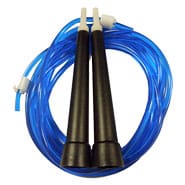
This here is the perfect jump rope for boxing training. The thin rope, combined with the 90-degree connection, spins easily and perfectly for a typical boxer’s rhythm. The thin plastic handles are effortless to hold which lets you concentrate on the rope and doing tricks.
The 90-degree connection helps the rope spins easier, avoids kinks, and also makes it easy to adjust the length. The rope itself gives you a perfect resistance (not too little or too much) which helps you develop coordination and rhythm.
These ropes are usually bought online since you won’t find them in typical stores. They used to sell the exact same ones I use (called “The Boxer’s Training Jump Rope”) but not anymore…so I found an updated version of it that I think is even better (basically you want 5mm rope, not the super thin ones):
Plastic Licorice Rope WITHOUT 90 degree connection – 2nd best option
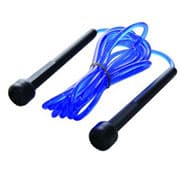
These are usually the cheapest and most abundant option in sporting good stores. They’re perfectly fine for boxing and quite the bargain at only $5. The problem with these ropes is that they don’t spin as easily and don’t last as long because they don’t have the 90 degree connection. You’ll be able to do all the basic tricks but double-spins will require a little bit more effort.
With increased use and increased speed, the rope will eventually crack the plastic handle at the very top. For a newbie jumper, this might take a couple months to happen. For an experienced jumper, this could happen in the first week.
These are usually called “Speed Ropes” and go for $5.99 at your local sporting good store.
PVC Jump Rope – bad, crappy rhythm
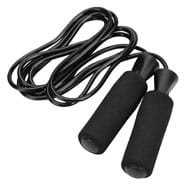
The most obvious PVC jump ropes are the black colored ropes with black-colored padded handles. They even have ball-bearings which are supposed to make the rope spin evenly but this actually turns out to be a hassle when you want to change the lengths of the rope.
A major problem with PVC ropes is that the rope stretches when you spin it at faster speeds and that easily screws up your jumping rhythm. Sometimes the rubber rope will feel too light and make it difficult for you to gauge the rhythm. You’ll see what I mean if you ever try one.
Leather – bad, painful & slow
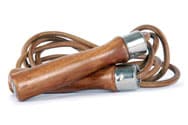
I especially HATE HATE HATE the thick leather ropes with the wooden handles. I don’t know why they’re being sold because they’re so terrible and useless. My main complaint is that they spin too slow and also that they’re too painful when you screw up. One session with a leather rope will make your back look like you got whipped in the middle ages.
Other jump ropes to watch out for
Expensive jump ropes – yes, the $40 ones do spin quickly but they are overkill for boxing. Those ropes are for doing quadruple spins and really fancy tricks.
Beaded jump ropes – these are ok, but require too much energy to spin in my opinion. They’re great for outdoor use because the plastic protects the rope.
Steel (or metal) jump ropes – my complaint with metal ropes is that they spin too easily. They’re too easy to spin and too fast for beginners. These ropes make it harder for beginners to learn the rhythm. Another thing is that steel ropes don’t stretch like the plastic ropes so they don’t give the arm as much of a workout. These ropes are better for tricksters and guys who like to do triple or quadruple spins. You have to compare to see what I mean.
Thick jump ropes – generally speaking, thicker ropes will always taking longer to spin because they require more energy. You might not notice this with single spins but double spins will be far more difficult if not impossible for beginners. Use thinner ropes so you can develop better coordination through faster spins.
Thick handles – I avoid thick jump rope handles because you end up focusing on the handle moreso than the rope itself. A slim plastic handle lets you hold the rope securely and comfortably with a relaxed hand so you don’t have to focus on “holding” the handles. (This is better for learning tricks.) It’s also better to have the resistance come from the swing of the rope rather than the weight of the handle. (This makes it easier for you to feel the rope and develop your jumping rhythm.)
Weighted jump ropes – so many guys keep trying to add weight thinking it’ll increase their hand speed but I disagree. Weighted jump ropes distract from the best qualities of the jump rope—which is developing coordination and rhythm. Adding weights renders it a more basic conditioning exercise and prevents you from developing higher level coordination.
If you want a more challenging jump rope workout,
increase your speed and trick difficulty, not the weight.
The right length for your jump rope
If you step one foot on the middle of the jump rope, the handles should come up to about your armpits. If you have long arms, you may want it slightly shorter. Beginners typically start with a slightly longer rope so they don’t trip as easily. When you get better, you will shorten the rope so it spins faster allowing you to do more advanced tricks and jump at a faster rhythm. With time and experience, you’ll eventually figure out the perfect rope length that makes it easy and effortless for you to maintain a constant rhythm.
You should also find a good surface to jump rope on. The floor should be firm but with a little bounce. Softer than concrete, harder than the ring canvas. The hard rubber surfaces typically found in gyms is good. Hardwood is ok, too. You’ll get shin-splints if you do it on a surface that’s too hard (like concrete) or too soft (like carpet). Don’t use your jump rope outside because the rough ground will tear the rope.
Now that we’re all set up, excited, and ready to go…let’s get to jumping!
How to Jump Rope for Boxing
The best way to learn how to jumprope to try it for 30 minutes straight every day for a week. (I actually went at it for 2 hours, but it’s ok…not everyone is me.) When you get tired and screw up, just calmly stop, set your feet, and try again. The important thing is to keep breathing at a steady calm rhythm as if you never messed up in the first place. Don’t sigh and panic.
It’s ok if you get so tired you keep hitting your shins. Just keep trying until the 30 minutes is over. 30 minutes will seem like a really long time but TRUST ME, TRUST ME, TRUST ME! Your body WILL adapt to that initial blitz. The more tired you are, the better–your body WILL learn how to be more efficient. After that first week, you will be able to jumprope forever.
I learned how to jump rope by just forcing myself to do nothing but jump rope for a week straight. I locked myself in the gym and jumped rope for 2 hours straight. I tired quickly in the first few minutes but after that, I calmed my breathing down and stopped panicking. All it took was for me to finally admit to myself that I “sucked”.
I put on my favorite music and just kept jumping. Sometimes I went 15 jumps without screwing up, other times I made it to a hundred. I was screwing up 4-5 times in a row but I wasn’t worried about failure. Every time I messed up, I just calmly stepped over the rope and started jumping again. By the next month, I jumped rope just as comfortably as anybody else in the gym. True story.
Boxing Jump Rope Tips
Some useful jump rope tips for beginners:
- Breathe only through your nose (this calms your breathing and increases endurance).
- Land on the balls of your foot with your knees slightly bent.
- Stand straight without curling into a ball in the air (this helps balance).
- Shorter faster jumps are easier than higher slower jumps (also better for developing rhythm).
- Spin the rope using your arms, not your shoulders (this keeps your shoulders and traps loose).
- Let the rope hit the floor gently so you have an audible rhythm to follow.
- Don’t stop during the rest periods (or try not to).
- Stop jumping if your calves are hurting (you risk shin splints).
- The goal is to jump as little as possible (the higher you jump, the more energy used).
Jump as low to the ground as possible.
The higher you jump, the more energy wasted.
The trick is to relax the jump
instead of pushing through it.
Basic Boxing Jump Rope Tricks
I’m sure some of you are dying to jump rope like Roberto Duran but first you’ll have to master these basic jump rope rhythms or basic jump rope “tricks”. Keep switching between the tricks as you jump and keep changing up the rhythm to give yourself a nice dynamic workout.
1. Basic Jump (single 2-footed bounce)
- jump with both feet together
- land on the balls of your feet
This is the most basic jump and serves as the foundation for all the other jumps. Beginners will trip and whip their feet a lot. You may even get frustrated and cry. whatever you do, just try again.
Try to get to 10 jumps without messing up. Then try to do 20. Eventually, you’ll reach 100 and you’ll feel like it was the hardest thing in the world. (The basic jump will eventually be as easy as breathing. Trust me, you’ll get there!)
2. Run in Place
- jump over the rope with your left knee up
- jump over the rope with your right knee up
- keep jumping over the rope as you run in place
- lift your knees high to make it more challenging
Running in place with the jump rope might be technically easier for some people but it’s physically more challenging especially when you go fast. It’s a better workout if you try to lift your knees higher (so that your upper thighs are parallel to the floor).
Some boxers will prevent themselves from tilting backwards off balance by leaning their upper body slightly forward. To add some intensity to your jump rope routine, try doing the “run in place” rhythm as fast as you can for the last 10 seconds of every round.
3. Side Swing
- put your hands together and swing the rope down on one side
- now swing the rope to the other side
- just spread your hands to jump again
- you can do the side swings while jumping or also while walking around (for resting)
This is a great way to rest your shoulders or give your legs a break. You can walk during the side swings or just keep jumping to maintain that rhythm; I prefer the latter.
You can also be fancy by using the side swing to speed up the rope before you do doubles or triples. The side swing is also a good way to recover if you mess up; just keep bouncing and side swing the rope until you’re ready to jump again.
4. One-Legged Hops
- jump twice on one leg
- then jump twice on the other leg
One-legged hops will develop the extra power needed to do some of the more advanced jumps. I like to do a pyramid routine where I jump on each leg from 2 jumps all the way up to 10 jumps and then back down to 2 again. For example: left 2 times, right 2 times, left 3 times, right 3 times, left 4 times, etc, etc. You can also make this a little more challenging by moving sideways as you’re doing one-legged hops. This will build some muscle all around your hip as well as your balance.
5. Basic Shuffle
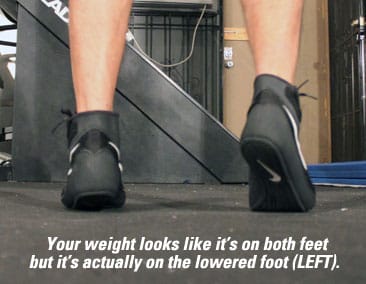
- jump twice on one foot, and then the other (just like you did for one-legged hops)
- gently touch the toes of the free foot to the ground so it LOOKS like you’re jumping on both feet but actually all your weight is still on one foot (the knee of the free leg will be slightly more bent than the knee of the working leg)
This will eventually develop your ability to do the boxer’s shuffle and give you that nice bouncing rhythm that all the seasoned boxers have. It’s not hard at all but it’s amazing that many fighters still can’t do it. If you want that nice bounce (or at least to stop looking like a rookie), start skipping rope more.
Boxing Jump Rope Training
Jump rope can be used as a warm-up or a cool down. Boxers will typically jump rope for about 10-15 minutes (3 rounds continuous without rest) as warm-up before their boxing workouts. If you can’t do 3 rounds, start with 3 minutes as your goal, then work your way up.
Once you get the hang of the basic tricks, learn more tricks to keep it from getting boring. Jump to some music or talk to your friends. Jump rope time can be your time to meditate or time to socialize. Once you get used to clearing the rope, jumping rope is not much harder than a jog.
You can make it as challenging (fun) as you want. Try changing the speed or try different tricks, whatever you want. You can mimic boxing round intervals by increasing the pace during the last 15 seconds of every round and then slowing the pace during the rest periods.
The jump rope will eventually become addictive. It’s one of the few parts of your training routine that can be creative, fun, and different every time you do it. It develops your back, shoulders, and arms, as well as your legs. It improves your footwork, coordination, endurance, power, everything! Seriously…the jump rope is your magic pill!
There are NO SUBSTITUTES for jumping rope
Running is a dummy exercise that can be done with zero awareness. Ladder drills are better but they still don’t force you to have that perfect rhythm and efficiency the way the jump rope does. Jumping rope requires you to maintain that minimal level of awareness and coordination that helps you stay calm and relaxed when making quick movements in the ring.
The level of awareness you use for clearing the rope could also be used as offensive or defensive awareness in the ring. A boxer that jumps rope will be far more alert at his resting rhythm and move with a more natural quickness than one that doesn’t. The jump rope is a great exercise for developing your overall athleticism and cannot be substituted with anything else.
Jumping rope is THE BEST EXERCISE
for developing footwork stamina and footwork efficiency.
Ready to learn more jump rope tricks?







wow another excellent article. I have to admit I suck at jumping ropes, infact I injured my shin trying to imitate sugar ray leonard. then i healed, but everytime i jump rope again, the pain gets back. I haven’t jumped rope eversince.. how can i overcome this?
don’t skip.the skip brothers
it’s also great cardio
very fun too 🙂
Do some rehab exercises to strengthen your calves and foot muscles.
Hey Johnny do you think these are good jump ropes? if so which is the better of the two? Thank you.
http://store.titleboxing.com/tko-lightweight-jump-rope.html
http://store.titleboxing.com/title-licorice-speed-rope.html
Both are comparable to me. I like mine so much better.
Thanks Johnny, I have been using a jumping rope for a year, but I haven’t known it’s so important in boxing. Great article. ;))
Man i need a jump rope, started training recently. Mostly just pushups, abs, and other plyometrics(squats), along with shadowboxing, find myself off balance alot more than id like haha. But ill deffinately invest in a ump rope thanks johnny
I LOVE rope skipping! I also enjoyed the learning process a lot. When you’re good at it, you realise that jumping rope is the most relaxing bit of a boxing workout 🙂
I personally find steel ropes with 90° connections and ball bearings to be the best. They’re not very expensive ($20ish) and the weight of the rope makes it a lot easier. Also if you hit your shin with that steel rope, you have a very good argument to learn it better 😉
When i jump rope for too long my heels start to hurt, maybe its the way im doing it, this is somewhat off topic but should i go to the gym for a 9-1 5-9 type schedule getting 8 hours in, or should i get five hours straight and work on cardio or shadowboxing, for a couple hours then get in the gym for five?
Hi j,
May be your are jumping rope with flat feet or after a long session when you become tired your heels get started to touch the floor/or mat. Just try to jump only with your balls of your feet….
Try both and see what works best. 2 hours of hard training is the most an average body can handle. Any other time spent in the gym is basically warm-up and warm-down.
Jonny I use this jump rope http://www.argos.co.uk/static/Product/partNumber/9269598.htm
any good?
Did you read the article? “Weighted jump ropes distract from the best qualities of the jump rope—which is developing coordination and rhythm. Adding weights renders it a more basic conditioning exercise and prevents you from developing higher level coordination.”
No, I wouldn’t recommend it.
“went at it for 2 hours, but it’s ok”
___________________________________________________________
Johnny..You mean two hours with no mistakes, non-stop? Damn, Bro 🙂
With the rope, you really can’t ask for a more effective, efficient and portable workout. I love it.
If you keep reading you will find out….
That’s great, Johnny..BTW, I’m going to get that rope you suggested.
Non-stop but of course, I make a ton of mistakes especially when I’m trying all sorts of jump rope tricks.
What do you think would be better for boxing a double sided mouth piece or single and which brands and specific mouth pieces do you like?
It’s called “Skipping” not jumping rope!
WHAT?! I’ve been sayin’ it wrong all these years?!
I like double-sided mouthpieces for sure. I use BrainPads.
OMG i own the leather rope! Didn’t know it was so terrible since i haven’t tried another. Damn it Johny now i have to buy the recommended one 😀
Thank you very much for this, even my coachers didn’t mention something like that all these years…
Leather–OUCH! Get the speed ropes!
” It’s truly a shocker that more sports do not skip rope as a standard exercise.” I completely agree with this Johnny. I feel pretty stupid now for not jumping rope when I did high school sports, and it puzzles me that I don’t see more people doing it. Once I started jumping rope I could feel the improvements all over. It’s also pretty fun. No lie, I sometimes dream I’m jumping rope and coming up with new tricks.
Ahhh yes, the imaginary rope dance. I’m doing all sorts of triples and quadruples when I jump rope in my head.
Great article!
Just had my first day of the week of 30 minutes straight of jump rope to try and get better. Found myself tripping up a lot and thinking half the time was spent re-setting up from my falls (does it still count as 30 minutes straight? :S) But yeah definitely going to keep at it. Any ideas for flooring substitutes/covers I can use in the home to jump rope on? Only space in the house I have to jump rope is on tiled floor (which I assume isn’t good), and it would be great if I could have better flooring so I could jump rope more often at home. Thanks for the article though, really sparked the motivation to get myself that bounce I need.
Awesome job, Justin. I’m glad the article worked to convince you!
The cheapest alternative I can think of is to go on craigslist and or online and look for HARD rubber gym mats (they’re usually a dark grey/black color). You can get the thin versions so they don’t cost as much and then put a layer over your tile floor.
Horse stall mats from rural king or any farm supply store are the best for gym flooring that weights will be moved around on. Nice thick rubber mats
I also get stuck jumping on a really hard surface most of the week (concrete), I shall try to look for that hard rubber mat.. It doesn’t make it harder to jump rope though, does it? The rope won’t snag on the rubber mat as it hits it on the downswing?
No, the rubber is not going to mess up your rhythm.
Don’t know if any of you guys are experiencing this too, but something I’m coming up against when I go over 30 minutes skipping is chafing of the nipples.. I don’t know if it’s really just natural or it’s because I started doing the crossover trick and it’s pushing my shirt against my chest more than usual.
Sounds like a natural thing, Arthur. You can see if a different shirt material would work better for you or cut down the amount of time you jump rope, 30 minutes is probably overkill anyway. Marathon runners experience this a lot, and I think some of them use some type of tape to cover their nipples.
Arthur, I used to run a lot way back in the day. I used to put vaseline on my nipples and I also bought running tank tops with soft material running across the middle of the tshirt for my longer runs. Like a wide soft strip running across your chest to avoid chaffing on the nipples. I know your pain. Good luck and enjoy your jump rope.
This is due to the irritant material on your shirt. Juat wear a cotton shirt and you will be fine. And also putting some vaseline over my nipples worked out for me.
I came across this jump rope system online. It has been getting alot of great reviews. I was wondering if you could check it out and let me know what you think.
http://crossrope.com/
I’ve never tried it but it looks like overkill for boxers. Boxers need only something simple for pure coordination work. A light simple $6 speed rope is all we need. Weighted ropes are unnecessary and not recommended.
This Crossrope stuff would be great for a Crossfit or other hybrid fitness junkie who like these sort of things. Are you a Crossrope associate?
No, I just dont like to lift weights and I thought this looked like an intense circuit training method that I could incorporate with my heavybag routine.
You can try the exercises I put in the “EASY Boxing Workout”.
Wow those workouts look great! Unfortunately I do not have a membership at my local boxing club right now but I am definitely going to try incorporating some of those exercises that I can do at home into my routine.
Hi johnny,
What do you think of the speed rope with removable weights so i can prefer skipping without the weights..im not sure if the material and the handles will fit me best..thanks
I don’t like jumpropes with weights. Especially not for beginners. The focus, as I said, is on coordination.
Dude this article is awesome!!! It’s a lot harder than you would think to just find a place with some straight forward information and no product placement or agenda! One question, where did you get that sick green color??? I want an orange rope 😛
Look up the recommended site and see what colors they have.
Wow awesome. Im so much better in the first half an hour. Skipping is a great heart starter! Everyone should be doing it! Thank you so much…. Im a pretty unco-ordinated peron and unfit so im
Trying to improve both of these areas and this will work amazing. Also helps me forget about crappy moments during the day. Cheers. As for the skipping comment lol yes its skipping but if youthink about it jump rope seems to fit, maybe its because your jumping over a rope hmmm 🙂
I’m a Tae Kwon Do instructor with 20+ years of teaching experience and another 26+ years of competition and training.
I completely agree with this article, top to bottom.
Nothing delivers cardio conditioning like jumping rope–I still do it between 45 minutes to an hour, twice a day.
Footwork is just as essential in TKD as in boxing; fighters need to constantly be in motion; sideways, back and forth shuffles, rapid-fire hop-switches; all predicated on the light bouncing motion described in this article.
We also execute many front-leg techniques that require the ability to spring off the back leg, which demands calf-development and balance; and change the direction–even the kick itself–in mid-flight after its been launched. This requires balance and coordination. Nothing delivers these benefits like jumping rope.
All my students must be able to jump rope for 10 minutes before being eligible to promote for black belt.
Excellent article, and thank you.
Thanks for sharing, Larry. I have a lot of respect for TKD competitors as the sport requires so much raw athleticism to be jumping around and kicking constantly. Being able to jump rope for 10 minutes is definitely a good requirement. It’s amazing and so many martial artists aren’t aware of and can’t jump rope!
Hey johnny what do you think about steel skipping ropes? Also i have a leather skipping rope because i kept breaking the plastic skipping ropes :-/.
I don’t like the steel ones as much because their rhythm feels a bit different and they don’t feel as free-flowing to me as the plastic one. You’ll have to use one to see what I mean. But who knows, maybe you’ll like it. The plastic ones shouldn’t break if you’re using them indoors instead of outdoors on a rough surface.
Hello,
I’ve recently begun skipping/jumping rope and I absolutely love it! I’m on a 20 day challenge, going on day 13. I’m considering getting another rope because the one I have loses its rhythm or something. I like the one you displayed with the 90 degree rotation. Where can I get that style. You would think it was easy but I’ve had no luck. Is it possible for you to post a link or site
Thanks,
Rob
The link is posted in the article.
Hi,
I started skipping a month back after a fairly long break. After a few days i started developing pain in my shin. When the pain became too much to bear I stopped for a week. During this period the pain subsided to a considerable extent, When I started skipping again after the break, I decided to skip on alternate days, as opposed to doing it every day. It does not pain as much now but if i skip for more than 20-25 mins the pain tends to come back. Is there any remedy for my problem???
Shin splints can be a result of bad technique, bad surface, bad shoes, or over-training.
Secondly. Is a speed rope also good for doing tricks such as cris-crosses? I use a speed rope.
Yes, speed ropes are great for tricks.
You said the pvc jump ropes are bad because they stretch, but on the link you gave for the 90 degree jump rope, it says, “Solid core 5mm PVC cord.” Can you tell me what the difference is?
I was going to buy this rope and just remove the weights. But I’m afraid it’s the stretchy kind you talked about.
canadiantire.ca/AST/browse/5/SportsRec/4/FitnessWellness/ SpecialtyEquipment/PRD~0840719P/ Tempo+Weighted+Jump+Rope.jsp?locale=en
When I say PVC, I’m referring to the ropes that are called “PVC jump ropes” and look like the one I pictured above. The ones in the link you put are definitely PVC and I all around hate those. They’re nowhere near as good for boxing.
Thanks Johnny. I found one with “PVC vinyl cord”. Is it supposed to be vinyl?
www. 360athletics.com/fitness-TAF_Y89.html
These are ok but I prefer the one with the 90-degree connector.
Now that I looked at it again, the picture looks the same as your plastic licorice ropes.
Hi good day Sir. I was wondering what kind of affordable alternative and stable flooring (that won’t slip when put onto a concrete) would you recommend to jump rope into? I’m only a beginner and I plan on jumping rope for 3-5 mins before dynamic stretching for my warm up exercise before playing basketball. I live in a rural area in the Philippines and gyms are far and costly considering that I’m only going to the gym just to jump rope on their rubber mat floor. Thank you and God Bless.
You can look up rubber flooring that people use inside their garages or maybe buy some thin foam padding and put wood laminate over it. I’m not the expert on this. You can also go to your local basketball gym and jump all over their wood floor, it’s a perfect surface for that kind of impact.
I made the right decision of quitting the gym. I just joined a boxing / kickboxing club for two weeks now, it is a hard cardio but fun. I have a small home gym equipment and upon reading articles from your website It encourages me to do more cardio than lifting weights. I suck at running but pretty good at jumping rope so i will stick to it. Still have a long way to have a better overall physical and mental endurance but I am positive that I will lose more weight before fall season.
I thought jumping rope was more than twice as beneficial as running. I had assumed if you could jump rope you could run as well. Am I missing something here?
I would say skipping rope and running are two totally different exercises. Running is good for cardio. Skipping rope is good for cardio and coordination.
Hey Johnny I have a question about iron skipping ropes. Would u recommend an iron skipping rope which is wrapped with hard plastic? It also has 90 degree connections…
I don’t like those as much because they spin too fast and don’t have the same “whip” feel because the ropes aren’t stretchy.
I carry on reading this fantastic article to find some solace in your comments on failure. I’m on my 4th day jumping rope and on my 2nd rope due to an anger issue I never knew I had until attempting this exercise. This exercise makes you think but you cannot afford to be tense, it’s like nothing I’ve ever tried.
Thanks Johnny, another cracking article, I’ve recommended your site to many of my friends in Guernsey
Update: I can now jump rope fairly uninterrupted, footwork has already shown a noticeable improvement. Balance and bounce is not as tiring, fluidity improved.
Good job! It’s such a great exercise, isn’t it? It’s a shame so many people refuse to do it.
Hi there Johnny. Would this rope be as good as your recommended one?
http://www.amazon.co.uk/Speed-Jump-Rope-Adjustable-Guarantee/dp/B00CDKKG2W/ref=sr_1_3?s=sports&ie=UTF8&qid=1373845530&sr=1-3&keywords=plastic+speed+rope
It looks very similar so I don’t see why not.
Great article, Johnny! What do you think about coated cable ropes? I’m in Australia & am finding it hard to find the one you recommended (the plastic speed rope with 90 degree connector) and the postage costs more than the rope to buy it from USA. Here’s one that I’m considering… do you think it’s OK? I want to use the rope for multiple unders. http://www.rogueaustralia.com/products/SR%252d1-SPEED-ROPE-.html
I don’t like metal ropes because they spin too fast and don’t give the arms a similar workout. The plastic is perfect to me because of that slight stretch. The stretch will also help you develop rhythm. Metal ropes I would say are better for tricksters and people who like to do triple or quadruple spins.
Thanks for your advice, Johnny. I managed to find the one that you said was the 2nd best option -plastic type rope without the 90 degree connector and it works a treat. I tried several types before (leather, PVC, wire), but the one that works the best for me is the plastic one and it was the cheapest one too! 🙂 The leather one was the worst.
Great article – I mix up jump rope with push ups and sit ups, and it provides me with my one stop shop conditioning training all within 45 mins. No gym needed, no money spent. I prefer the beaded ones as they don’t warp or get out of shape. Had two years heavy work on mine with no problem. Also skipping is great for soccer. I too just don’t understand why more people don’t do it
Have a great music with JUMPING ROPE IN RELAX TIME by Alessandro SPINA (Italian Composer & Jump Roper). With Comments, Likes and Shares you can support it. 🙂 http://youtu.be/Lr_HvW46Lb8
I’m 13 I’ve been skipping at my gym for about 3 – 4 months now and I’m really good with tricks and stuff but when I do the normal skipping on 2 feet I stuff up after 20 – 30 secs I can do double understand cross overs and all that but can’t jump normally am I weird or is it cause I’m always doing tricks Instead of just normal jumps
Thx for the great article
The regular 2-legged hop is actually pretty tiring because both legs are working whereas your legs get to switch off the work when you’re doing tricks and jumping from one leg to the other.
Double unders* soz auto correct not understand hahaha
Thx Johnny that’s props y I’m gonna just try and stick with the 2 foot jump and build my endurance up
Great article. I’ve used ropejumping since Rocky 3 came out in 82′. I’ve stopped and started with it over these 30+years but always come back to it. Jumping rope seems to help my paddling(for surfing) because it trains those weird little muscles in the shoulders that weights don’t reach. Thanks for the motivation to continue on. Later.
Hey Johnny!
So i’ve taken the advice from this post and taken up skipping. I used to skip a lot actually and ive only just remembered how fun it is, however the last time i jumped rope was probably about 10 years ago haha (i’m 18 now) so obviously i dont actually have a ‘proper’ rope from a store. Eager to get back to skipping i’ve used my initiative and cut up a washing line as a temporary jump rope. However, this is just not gunna do the trick long-term so ive been browsing and found a rope which im thinking is just the ticket. What do you reckon to this? http://store.lonsdale.com/lonsdale-club-skipping-rope-761137 It’s nylon and you dont say anything regarding these ropes above so thought i’d rack your brains in the comments, cheers!
Those will work just fine. They are the same as my 2nd choice ropes.
Thanks for your great article
There is absolutely no greater workout than jumprope.
I use the leather rope with wooden handles-what a cardio blast
I coach high school football, and train with the Jumprope for my Military PT Test
The only thing that comes close to the jumprope for me is windsprints
You can’t go wrong with the jumprope !
I love your site very helpful Thanks to you I’ve been able to pick up boxing faster than the other beginners at my gym. My boxing coach had to get surgery on his leg. He had to get a metal rod inserted in his bone because of the many years of jogging and landing on his heels. I’ve read that the proper way to jog is to land on the balls of your feet to prevent this type of thing from happening. Running 6 times a week and landing on my heels have made it really difficult to jump rope because of the pain, I think it’s shin splints. What can I do to fix this because I want to keep jump roping but sometimes it is just too painful. Thanks a lot for your help man take care!
Stop landing on your heels. Stay on the balls of your feet when you run.
In your article, you say if your calves start to hurt, stop or risk shin splints. Dumb question, but stop for how long? Long enough to catch your breath and go again, using calf pain as your limiter until 30 mins has elapsed or stop! You’re done for the day, see about it again tomorrow? Thanks for this great website, I’m very new to the sport and it is a fantastic reference.
Done for the day, and maybe even give it a couple days break.
Hi johnny I would like thank u for the great article :)and somewhere I heard that cardio exercise decreases the muscle mass and stops the promotion of gaining muscle mass is that true?? Cheers
It’s kind of true, but it’s not necessarily a bad thing. Boxing is all about having functional muscle and a strong focus on endurance.
Dear Johnny N,
Do you know if some manufacturer makes a folding wood gymnasium just the size for jump roping? If not, someone should invent that for this purpose. I have read all your comments and it seems the only thing so far is the rubber puzzle block flooring?. Thanks
I don’t know of any at the moment, Brenda. Let me know if you find one.
Just go to your local hardware or flooring store and buy a pack of the click together laminate flooring. Or floating flooring it’s sometimes called. That will give you a good deck to skip on, it bounces back a little unlike concrete….. and it won’t bounce the rope up like carpet does.
Thanks Johhny for your great tips.
I have found 20 minutes of jumprope makes me feel like a star
The workout I get from jumproping is far far far far better than jogging.
The next best workout is 60 yard sprints.
I hate, hate, hate the 90 degree handle ropes
Jumproping is just fantastic!
I’m happy for you, TG. I hope your enthusiasm infects everyone else because we need more fighters on the jump rope!
I always learn many boxing tips on your site.
Thanks for your guide.
Tnx for ur wisdom in youtube my friend…johny nid help im from the philppines..but it sucks here and frustrating since most jump ropes are imported from in china very slow and not durable..poor quality…filipinos are not interested in jump ropes thats y they dnt make jump ropes. They just build basketbol courts…pls help me I wanna buy he 90 degree licorice rope like yours..im good in double unders and mayweather styles criss cross sprints but my rope sucks…u think I need to pay shipping fee online? Tnx man…you can email me as well..godbless
http://store.titleboxing.com/fighting-sports-plastic-licorice-rope.html
good rope?
You said that PVC ropes are “bad” with a “crappy rhythm” but then go ahead and recommend…. a PVC rope.
No worries, you totally misunderstood because it’s a confusing subject for those who don’t know. And unfortunately, the subject continues to baffle many because of the ridiculous (an unimaginative) product naming system.
There’s a difference between a rope called “PVC rope” and a rope made out of PVC.
– the former is a bad rope with crappy rhythm
– the latter is a good rope
– the difference? perhaps in the quality and build of the PVC material
Hey love your articles I weigh around 14 stones and haven’t boxed in years I want to get in shape will jump roping make me be able to fight for longer without getting tired? I.e first round I feel great around the second I get slower and my hands keep going down
The answer is in the article.
Hey, thanks so much for this! I’ve recently started jumping rope and it’s already made great changes to my footwork and endurance, but I tend to get pain in the arches of my feet. Is this a problem with my technique, or should I see a podiatrist? I only have half arches.
Talk to a specialist. I have a feeling it has to do with the kind or shape of shoes you’re wearing and maybe also your technique.
sir
i have been jumping rope for the past 25 days i have felt good i just want to ask you that how much skipping should one do and in how many days can i expect to loose weight if i skipp around 1000-1200 everyday ? ..
Please answer
This answer is different for everyone and I really don’t know the range myself. 10-15 minutes a day is a great start. If you want to do more, do more. But for weight loss, you need more than just exercise. A good diet is absolutely key. You can check out my “Common Sense Boxing Diet” for more great tips and also my “30 Day Fighter’s Diet” if you’re serious.
Hey I just recieved the jump rope you highly recommended, But I have problems adjusting it & need help please! Can you make a quick Tutorial on the 90 degree jump rope?
You don’t know how to shorten the rope?
As a southpaw Im supposed to move to the outside of the orthodox fighter’s front foot but sometimes I watch Guillermo Rigondeaux and sometimes he moves towards his opponents right hand. Why is that? Especially in his fight with Donaire.
It works!
I just feel “level up” after trying this for a week.
Hi Johnny,
thank you for the video on selecting a rope and the piece on how to. The reason I am looking for help on jump rope is the new teacher is super keen on a skipping warm up. Everyone else can do the boxer shuffle jump rope, I am the oldest (but I skip like school yard style). I use a length of electrical cable, skipping was never a big issue with the previous teacher. I want to comply with the new teacher’s way, so I am buying the jump rope as per your suggestion.
Can I ask you to consider a video where you show how to move on from a school yard up and down basic into the boxer’s basic of one foot skip, one foot forward, (at least that is what it looks like when I watch the others. Please let me know if you do, so I don’t miss it.
I know the right rope to buy thanks to you, and I will have it before the next training session.
Bye for the now.
Cheers from Peter.
Dear Johnny,
I have been mixing up my workouts lately,
but nothing, and I do mean nothing makes me feel more lean, and gets my hear-rate going better than 30 + minutes of Jump-rope.
This is the way I feel after a 3 to 5 mile Run.
This is my testimonial to the rope-you cannot beat it for Cardio
Hi Johnny,
Thanks for such a wonderful website! I had a quick question on jump roping.
Q: Do you recommend taking one minute rests between each 3 minute round of jump roping, like an actual boxing match? Or do you recommend doing straight blocks of time such as 20 or 40 minutes of straight jump-roping instead (not taking any rests?)
I’m able to go longer and skip rope better if I do 10 or 12 rounds with a one minute break in between, but I’m not sure if this is “correct” for training. Thank you for your time.
Hey Johnny, where did you buy that little pyramid weight on the floor for the double end bag? And I have the Everlast Pro Heavy Bag Stand, if I had a weight like that, could I use the heavy bag stand for the double end bag or the speed bag swivel on the back?
Hi Johnny,
Great article (I love all of your articles ;)). I am trying fow a while now and are able to do the basic jump and run in place. However, the one legged hops are not really successfull (let alone the basic shuffle). The one legged hop feels a bit “forced” (not natural or with a flow) and I have to jump higher that with the basic jump (also I pull up my other leg quite high). Is it just a matter of keep on trying or do you have any useful tips?
Keep up the good work!
Hello, I am an old geezer who is getting back into jumping rope at 56 years old. Your article and the advise you give in the comments section really inspired me. I bought a $18 jump rope but it’s not the lousy ones you described. We also have a small aerobics room here at work with a wooden floor, perfect for jumping rope. Thanks again.
An excellent article. I am a serious rope jumper and it’s a fact that numerous sportspersons fail to realise the kind of role this exercise exercise is capable of playing in their preparation and conditioning routines.
I have tried different mixed circuits. Each 3-minute round of rope jumping can be followed by 8-10 reps of a compound barbell or dumbbell exercise at a slow pace. The “time loss” in the process will serve as the rest period between the rope jump rounds. These circuits are indeed very taxing yet effective. The total number of rounds can be gradually increased. IMHO this method is better than nonstop rope jumping.
Thanks for all the advice on ropes! I’m glad to find that the cheap one I bought is one of the better options. I like to jump rope to work on stamina for Highland dance*– which is very athletic and comprises constant jumping up and down (in fact, whenever someone asks me what it is like to perform, I tell them to imagine jumping rope, but with precise and complex movements). It allows me to focus on building stamina and good elevation without the complex movements of dancing. Definitely helpful. (More dancers should probably do it– especially those who also need work on keeping a beat.)
*Highland dance: https://www.youtube.com/watch?v=9Ht0faGp2wo
Hi johnny
Well I see a lot people do rope jump but I also read doing rope jump must carefully plan the time and place example are during hot day and cold day.Since doing rope jump raise blood pressure,heartbeat and temperature I suppose plan out are recommend it is?Enlighten me Johnny or anyone.
Would you recommend rope jumping before boxing or after boxing
Hi johny
I have been doing role skipping for getting ripped and lean muscles.I m skippi g for six months and use to do this for 35-40 minutes .I use to skipping around 5000 ropes a day.is it going to create nay problem related to knee joint pain in future.I m just worried about it.
Hi Johnny,
I am not sure if this question has been asked before but for how long should a boxer jump rope? My trainer used to let us jump rope for 30 minutes straight as our warm up before every session we did. No breaks in between. At first I thought that he was crazy and that he was joking, but he has very unconventional training methods, we used to box for 5 minutes a round instead of 3. Boxers that I know from other gyms all jump rope for 3 minutes and a 30 second break. But I found that the longer I jump rope with no breaks in between my footwork and endurance improved dramatically as well as my jump rope skills.
Regards,
Leroy
Hey Johnny! That jump rope u r recommending, where can i get that in India( could u just recommend any site). But it has to be a little cheap. When I checked the rope on Amazon, including the shipping charges it costs around $40-50 and I am not willing to go above $10 . Hope u reply soon. Thanks in advance!!
Hi johny!
I have a problem that i cant move my left wrist in the good direction and even i cant draw a circle easily with my left wrist without rope 🙁 but i think my right wrist is ok. And this cause the imbalance of the rope and …
How can i fix this prob?
Is your wrist injured? Or is it naturally this way?
No i dont think that its injured.
Hi,
Thank you so much for making this guide! I have been using the stretchy PVC rope and after reading this I only realized its problems. I clicked on the link of the best rope you’ve suggested, but it says its a thicker rope than normal, is this ok for a beginner to use or should I get a thinner rope?
Thanks!
I linked to those because that is exactly what I recommend. If you get a thinner rope, it will be too light and too fast which means it’ll be less of a physical workout and too much of a mental workout. You are not trying to be jump rope trick champion, so getting a thinner rope will work against you for boxing purposes.
I just experimented with a weighted rope for the first time, after only using a speed rope for some time. It seemed like the weighted rope would be a great wrist workout, because I needed to engage my stabilizer muscles to hold proper form.
Dear Johnny,
I have been reflecting on the rope since I first posted years ago.
I would place the rope on neck and neck with Football Sprints and Weights.
Still after 20+ MINUTES with the rope you are ripped and ready for action.
Thanks again for your great article and blog..
I love the Jump-rope !!!!
Is it better to jump rope at the beginning of the training session or at the end of the training session?
I prefer to do it at the beginning but others will use it as a warm-down…or even both warm-up and warm-down.
You have no idea about boxing. Rope needs to be leather and heavier…..the first one you tossed out was the best one….
Hmmm…I wonder why all the pros aren’t using leather then…
Hey Johnny, any tips for bouncing without so much effort, I found my legs getting exhausted after 10-15 jumps
Hehe, be exhausted, but just keep doing it. Keep going even if you’re tripping every other jump. Do it for half an hour straight and you’ll get so much better, you’ll see.
Hi ! I’m Josef from Czech Republic (You might recognize me from the ExpertBoxing group here on facebook) and i just wanted to tell you something ! When I was reading the articles on the Eb website, I came across the Jump Rope guide and it pretty much changed my entire performance ! ? I always hated jumping rope, because I tripped over like all the time ! ? But then, I saw a video of Muhammad Ali jumping rope, and I just said to myself : “Man, I should give it a chance!” and I started jumping rope for 15 minutes every single day (I know I should jump rope for 30 minutes, but I will get there). It has been 14 days and I feel just perfect ! ? ? ? Today, m training session lasted 60 minutes and with the correct breathing combined with jumping rope every day, I just didn’t run out of breath !! ? ? ? We jumped rope in training for 6 minutes , and i didn’t tripped over even once ! Not once ! ? ? It was funny seeing my sparring partners gassed out and me jumping around and dancing like it was 1. round ! I still don’t know if I will win my fisrt fight, but one thing is for sure ! With stable breathing and jumping rope like this, I won’t run out of breath ! I know my story is really long, but I just wanted to say one thing. Thank You ! ? This one advice really changed it all for me. i’m really grateful for it ! Thanks again ! ?
Hi Josef. Thank you for sharing. What a great story. I will copy it to my jumprope page comments section if you don’t mind. I’m so helpful to hear how much of a difference it’s made. I know so many people who hate jumping rope the same way and think they will never be able to do it but then they end up proving themselves wrong! ?
Great post, thanks for posting. There is an aspect that nobody covers, which rope speed / rpms. And speed makes a difference. I can easily jump for 15 minutes straight at low speed but only few seconds at high speed. Now I cannot find any benchmark of what a “good” speed would be. For example how fast do professionals boxers go ? What is a “good” benchmark ? Like 120 rpm, 200 rpm, 300 ? Any ideas ?
Thanks!
Dear Johnny, please acdept my heartfelt thanks for your very instructive site, which I find very useful and consult often for about everything I can learn about boxing.
when I read this sentence:
“I can only guess that it’s probably because jumping rope is initially hard to learn and embarrasses even seasoned athletes.”
– my first thought was “what isn’t hard, in boxing?” O_o’
– and then, on the second thought, I had to laugh, because when the coach for the first time said “everyone grabs a rope and ten minutes rope skipping” I was rather happy, because it was the first time I felt I could do a thing right away and not embarrass myself all the time like when learning these wonderful but very weird boxing movements which didn’t come easily to me at all.
but this is probably because I have been a girl, and did quite a lot of rope skipping. and chinese jump rope with the elastic band, I don’t know if you know it. This kind of thing:
https://www.youtube.com/watch?v=gJuELrFOyXU
in the gym where I train there is a selection of ropes and I always come back to the leather ones. I find they hurt much less than every other make. I like the way they swing.
and If I may ask a question please: is there a reason why I should rather go jogging than rope jumping for cardio? I like the rope so much better, but I’m not sure if jogging brings a benefit the rope does not bring.
Running uses a different energy system–Long Running is good for your Aerobic System–Jumping rope is great for Anaerobic conditioning–like Wind Sprints on Steroids—-Most World Class Boxers do both–but for their long runs they are not running super hard like long distance runners—more like a tempo run or a Jog—I say jog for recovery a couple of days a week
I also wonder why other sports don’t incorporate jumping rope into their training. Sports like football, soccer, rugby, tennis, badminton, basketball immediately come to mind as sports that rely heavily on footwork. The better your body is coordinated and the faster you are on your feet the better. A split second can make all the difference and jumping rope could be that difference.
I agree with you Bob–Not only is the rope good for speed –It is fantastic for conditioning and breathing
Dear Jonny–It has been 7 years since I first read this article–It really helped me get fit for my Military Fitness Tests–I was like supercharged–I did 19 minutes today, and it felt Tremendous—Nothing compares–Thanks!!!!!!!!!!!!!!!
You can also check it out Honor Athletics Jump rope
https://www.amazon.com/Honor-Athletics-Speed-Rope-Skipping/dp/B07VY5GM4L/ref=sr_1_1?crid=378B0SIMPZ836&dchild=1&keywords=honor+athletics&qid=1599415481&sprefix=honor+ath%2Caps%2C157&sr=8-1
Fantastic article! Now why didn’t I read this long ago?
I am a retiree and just started doing boxer skip (just up to 20+ jumps) after six weeks of trying. Getting to like boxer skip as I find it less demanding than regular bounce or run in place.
Thank you
I just turned 60–Even 15 minutes at a time keeps you quick, fit , and trim
I still lift and run–But the Cadillac of exercise is jumping rope